Ha Giang Loop Tour Difficulty: Roads, Weather and Rider Requirements
A rider can leave Ha Giang on dry pavement and meet fog, loose gravel and construction mud before lunch. Add steep descents, buses crossing the center line and several hours of repeated corners, and a route that looks simple on a map becomes physically and mentally demanding.
Cuong’s Motorbike Adventure treats Ha Giang Loop tour difficulty as a combination of road surface, weather, daily distance, motorcycle choice and rider judgment. Experience in city traffic alone does not settle the question.
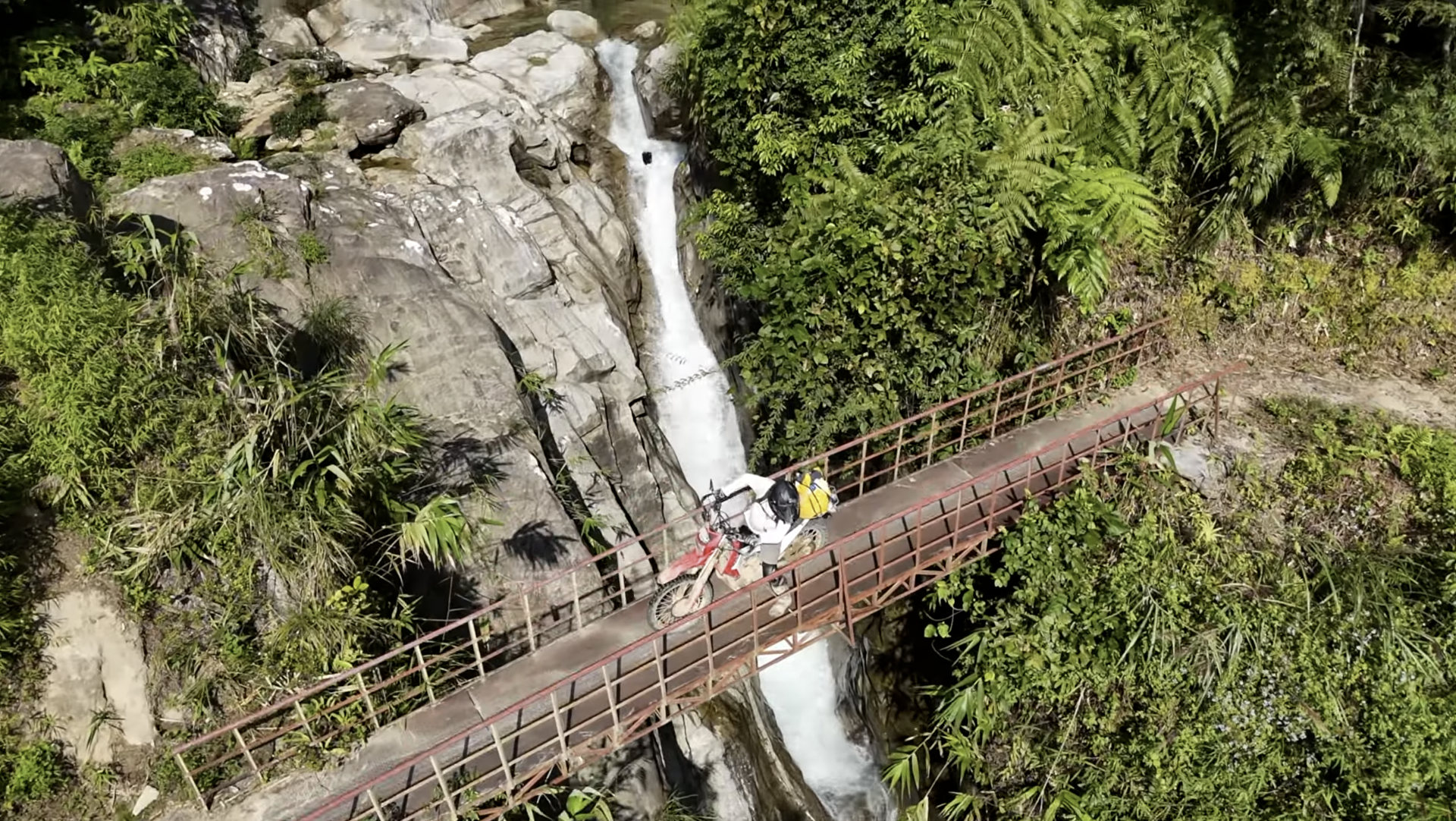
Quick answer: How difficult is the Ha Giang Loop?
Use these five steps to decide whether you should ride yourself, join a guided tour or travel as a passenger:
- Assess whether you can control a motorcycle on steep, narrow and occasionally broken mountain roads.
- Match your experience to a semi-automatic, manual road bike or dual-sport motorcycle.
- Plan for four to seven hours on the road each day, including stops and delays.
- Check rain, fog, heat and cold rather than relying only on a monthly weather average.
- Choose self-riding only if your license, insurance, bike control and mountain judgment are adequate.
A confident licensed rider with recent motorcycle experience can usually complete the standard loop at a conservative pace. A complete beginner should not use Ha Giang as a place to learn clutch control, braking or cornering. Joining a guided ride does not remove the need for riding ability unless you travel as a passenger with an experienced driver.
To make the assessment concrete, this guide follows a four-day example: Ha Giang to Yen Minh, Yen Minh to Dong Van, Dong Van to Du Gia via Meo Vac, and Du Gia back to Ha Giang. The example rider has two years of urban scooter experience but little practice on manual motorcycles or mountain descents.
Ha Giang Loop road difficulty and terrain
Most travelers do not struggle because every kilometer is technically difficult. They struggle because straightforward pavement can change quickly, and the consequences of a poor line are higher on exposed mountain roads.
The main loop includes paved highways, village roads, steep passes, hairpin bends, narrow sections and stretches affected by roadworks. Surface quality varies with maintenance and recent weather. A section described as paved may still contain potholes, sand, gravel at the edge or a muddy construction zone.
Steep climbs and descents
Long climbs require steady throttle control and an appropriate gear. Descents demand more skill because speed builds quickly and repeated braking can reduce control if the rider relies only on the brakes.
Use engine braking. Select a lower gear before the steepest part of a descent, keep a stable line and avoid grabbing the front brake while leaned over. On a semi-automatic motorcycle, learn how each gear behaves before leaving Ha Giang city.
The example rider begins the climb toward Quan Ba with familiar scooter habits. The automatic response is to brake late and coast into bends. That approach becomes tiring within an hour. After shifting earlier, reducing entry speed and holding a consistent line, the rider uses less braking and has more time to react to oncoming traffic.
Hairpin bends and limited sight lines
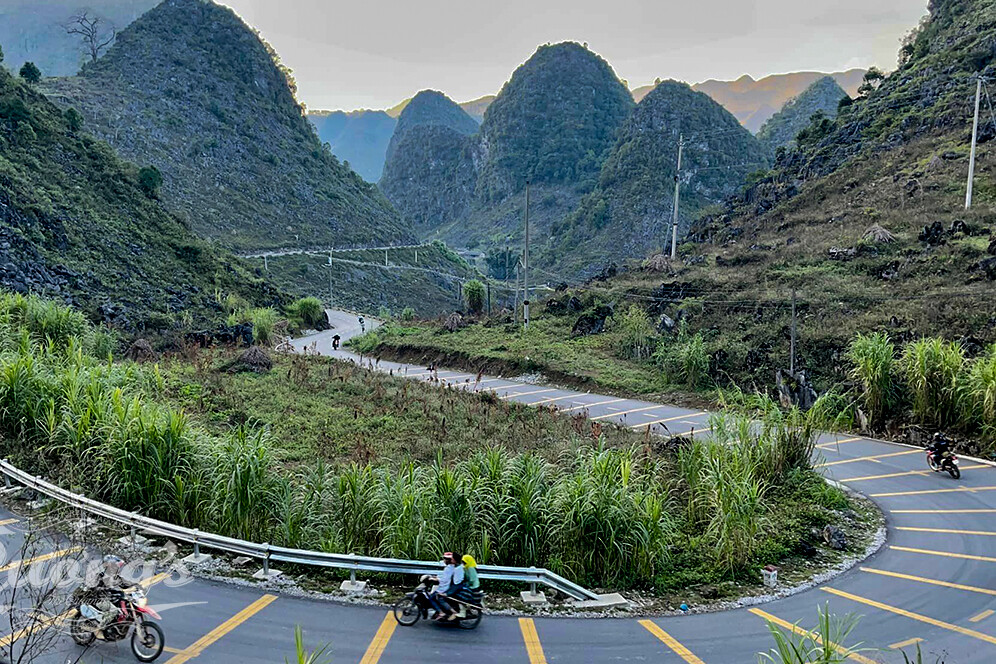
Mountain bends often hide trucks, buses, animals or stopped motorcycles. Some vehicles use part of the opposing lane to complete a turn. Staying near the center line leaves little room when that happens.
Approach every blind bend at a speed that allows you to stop within the visible road. Sound the horn where local traffic expects it, but never assume the horn gives you priority. Keep enough space from the motorcycle ahead to see the surface for yourself.
Ma Pi Leng Pass is visually dramatic, but attention belongs on the road. Stop at a safe pull-off for photographs instead of slowing unexpectedly in a traffic lane.
Gravel, potholes and road construction
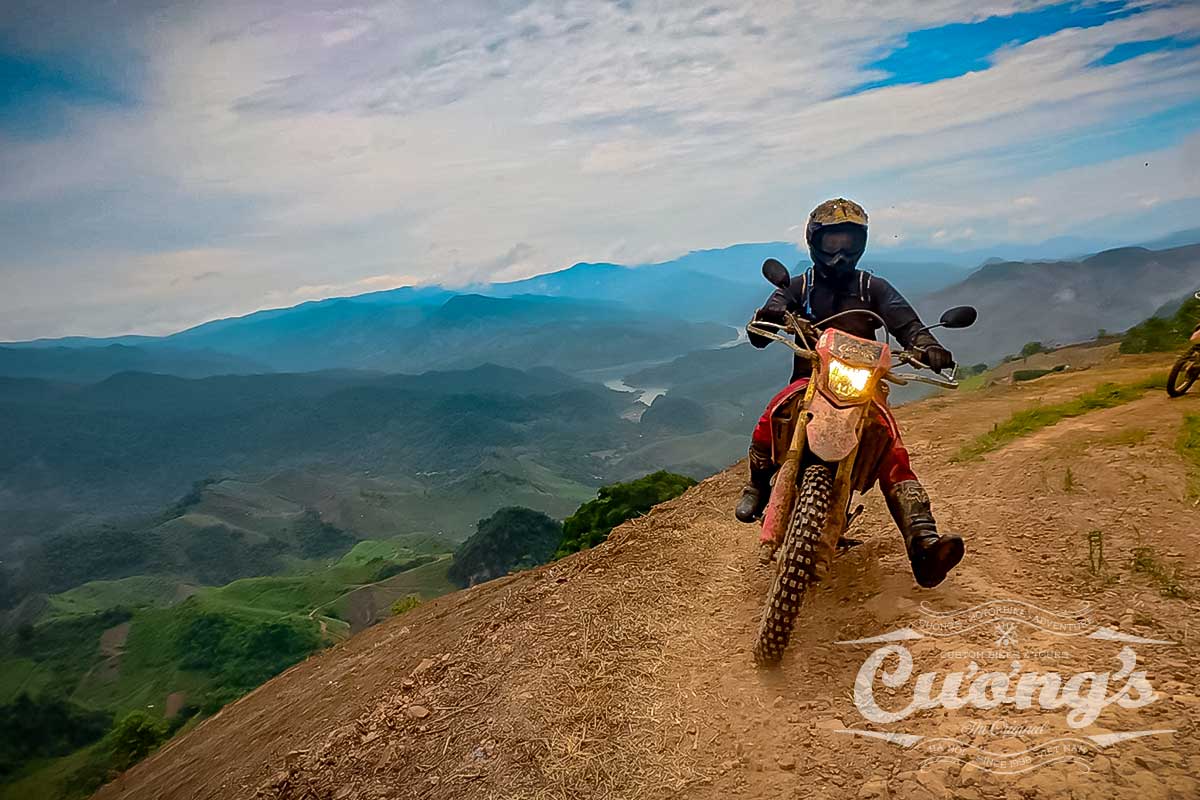
Loose gravel reduces available grip, especially during braking or cornering. Construction sections add ruts, stones, heavy vehicles and workers to the same narrow space. Rain can turn compacted earth into slick mud within minutes.
On loose surfaces, reduce speed before entering, keep the motorcycle as upright as possible and make gentle control inputs. Do not follow another rider closely just because that rider appears confident. Their tires, motorcycle and experience may be different.
The example route reaches a roadworks section after Yen Minh. The rider follows a local motorcycle too quickly, enters a gravel patch while braking and runs wide. There is no crash, but the mistake shows why urban scooter experience does not fully transfer to mountain riding. The next section is taken with a larger following distance and lower entry speed.
Road exposure and roadside protection
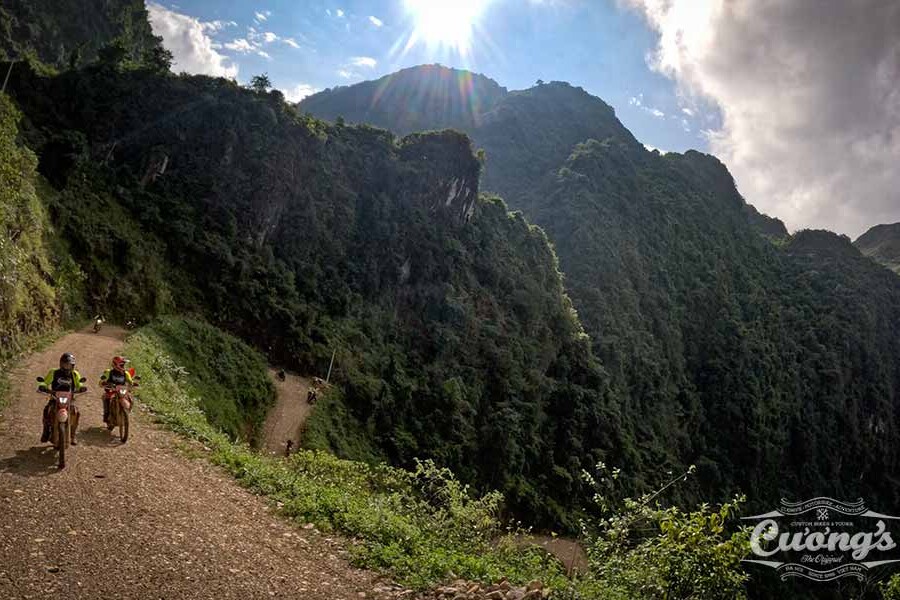
Some roads have steep slopes beside them, while barriers are inconsistent. Even where there is a barrier, hitting one is not a safe outcome. Riders who are uncomfortable with heights may tense their arms or stare toward the edge.
Look through the turn, not down the slope. Relax your grip and keep your vision where you want the motorcycle to go. If exposure causes panic or target fixation, riding as a passenger is a better choice than trying to force confidence on the route.
Ha Giang Loop difficulty by motorcycle type
Motorcycle choice changes both the physical workload and the consequences of mistakes. A light semi-automatic can feel approachable, while a manual dual-sport offers better control on broken surfaces but requires clutch and gear skills.
| Motorcycle option | Best suited to | Main advantages | Main difficulty on the Ha Giang Loop | Practical verdict |
|---|---|---|---|---|
| Automatic scooter | Riders with automatic experience on easier paved routes | No manual shifting and familiar controls | Small wheels, limited engine braking and less confidence on potholes or mud | Not the preferred choice for uncertain road conditions |
| Semi-automatic motorcycle | Riders already comfortable shifting without a clutch lever | Light, simple and common in Vietnam | Gear selection and steep descents still require practice | Suitable for competent riders using a conservative pace |
| Manual road motorcycle | Licensed riders with recent clutch experience | Better gear control and stable road handling | Stalling on steep starts and poor low-speed clutch use | Good for experienced road riders |
| Dual-sport motorcycle | Riders with manual and mixed-surface experience | Suspension, ground clearance and control on broken roads | Taller seat, added weight and more demanding low-speed handling | Strong option when the rider already knows the bike type |
| Passenger with a guide | Beginners, nervous riders or travelers without valid riding credentials | Local driver handles the motorcycle and road decisions | Less independence and limited control over the pace | Safest practical option for many first-time visitors |
Automatic scooters are not automatically easier
An automatic scooter removes gear changes, but that does not make every mountain situation easier. Many scooters have smaller wheels and less suspension travel than a suitable manual motorcycle. They also provide less useful engine braking on descents.
A rider who has only used an automatic scooter should not switch to a manual bike on departure morning. At the same time, choosing a scooter solely to avoid learning gears may create other limitations. Discuss the actual route and current conditions before selecting the motorcycle.
Semi-automatic motorcycles require real practice
A semi-automatic bike has no hand-operated clutch, but the rider still selects gears. Poor gear choice can leave the engine struggling uphill or allow too much speed downhill.
Practice starting, stopping, changing gears, turning tightly and restarting on an incline. A short parking-lot demonstration is not enough if these controls still require conscious thought. They need to feel predictable before mountain traffic is added.
For the example rider, a semi-automatic is more sensible than changing to a tall dual-sport with an unfamiliar clutch. The trade-off is slower progress on rough sections and greater care over potholes.
Manual and dual-sport bikes suit experienced riders
A manual motorcycle gives the rider precise gear and engine control. A dual-sport model can also handle damaged pavement and gravel more comfortably. Neither compensates for weak fundamentals.
Tall motorcycles can be awkward during U-turns, sloping stops and muddy sections. If you cannot restart smoothly on a hill, stand securely at a cambered roadside or control the bike at walking speed, choose a lower and more familiar machine.
Motorcycle size should support the route, not the rider’s image of the trip.
Ha Giang Loop daily riding hours and fatigue
A distance that takes two hours on an open road can occupy most of a day in Ha Giang. Progress is slowed by bends, villages, viewpoints, meals, fuel stops, livestock, construction and changing weather.
Plan for roughly four to seven hours on the road during a normal tour day. That is not four to seven uninterrupted hours in the seat. It includes short stops, but the concentration required across the day still accumulates.
A realistic four-day Ha Giang Loop pace
On day one, the example rider travels from Ha Giang toward Quan Ba and Yen Minh. The early start leaves room for a slow lunch and a roadworks delay. Arrival before dark matters more than adding another viewpoint.
Day two continues to Dong Van through repeated climbs and corners. Although the distance is modest, concentration falls during the last hour. The rider stops for water rather than pushing through. That ten-minute pause improves braking and line choice more than rushing to recover time.
Day three covers Ma Pi Leng, Meo Vac and the route toward Du Gia. Photo stops, traffic and surface changes make this the most mentally demanding day. Day four returns to Ha Giang, where riders can become careless because the trip feels nearly complete.
Fatigue often appears as late braking, missed gears, stiff shoulders or following the bike ahead too closely. Treat those signs as a reason to stop.
Why a three-day itinerary feels harder
A three-day loop can work for riders who start early, know their motorcycles and accept fewer detours. It leaves less flexibility for rain, construction or a mechanical delay. A four-day schedule is usually more forgiving for first-time mountain riders.
Longer is not always easier. A five-day itinerary with sensible stages reduces daily pressure, while an overloaded five-day route can add remote tracks and increase difficulty. Compare the actual roads and expected seat time, not just the number of nights.
Avoid riding after dark. Visibility falls, road defects become harder to identify and animals or unlit vehicles can appear with little warning. Build each day backward from a daylight arrival time.
How weather changes Ha Giang Loop tour difficulty
Weather can turn an appropriate route into a poor decision. Mountain conditions also vary by elevation, so sunshine in Ha Giang city does not guarantee clear roads near Dong Van or Ma Pi Leng.
Check the forecast each morning and ask for local information about the next section. Vietnam’s National Center for Hydro-Meteorological Forecasting publishes official forecasts and warnings, but mountain riders should also pay attention to visible cloud, recent rainfall and reports from the road.
Rain, mud and reduced grip
The first rain after a dry period can mix with dust and oil on the road. Heavy rain may create standing water, wash gravel across pavement or trigger small rockfalls. Unpaved construction zones become much harder for road-oriented motorcycles.
Reduce the day’s ambition when sustained rain arrives. Waiting for a severe shower to pass can be safer than continuing for the sake of a booking. If water hides the road surface, do not assume a puddle is shallow.
In the running example, rain begins before the planned ride from Dong Van. The original schedule includes extra stops beyond Meo Vac. Those stops are removed so the rider can cross the main pass slowly and reach Du Gia in daylight. Keeping every planned stop would turn a manageable day into a late arrival.
Fog and low cloud
Fog can reduce visibility to a few vehicle lengths. It also collects on visors, making sight lines worse even at low speed. Use a low beam, increase the following distance and avoid following another rider’s taillight so closely that you copy every mistake.
Bright high beams can reflect from fog and make vision worse. Keep the visor clean and stop somewhere fully away from traffic if visibility becomes inadequate.
Heat, cold and dehydration
Lower valleys can feel hot while exposed passes are cool and windy. Wet clothing increases heat loss quickly. Carry a waterproof outer layer even when the morning is warm.
Drink before you feel thirsty. Dehydration affects attention and decision-making, while cold hands reduce precise braking and throttle control. Gloves should protect the hands without making the controls difficult to feel.
Seasonal averages help with packing, but they cannot confirm whether a specific road will be safe on a specific day. Route decisions belong to the conditions in front of you.
What riding experience do you need for the Ha Giang Loop?
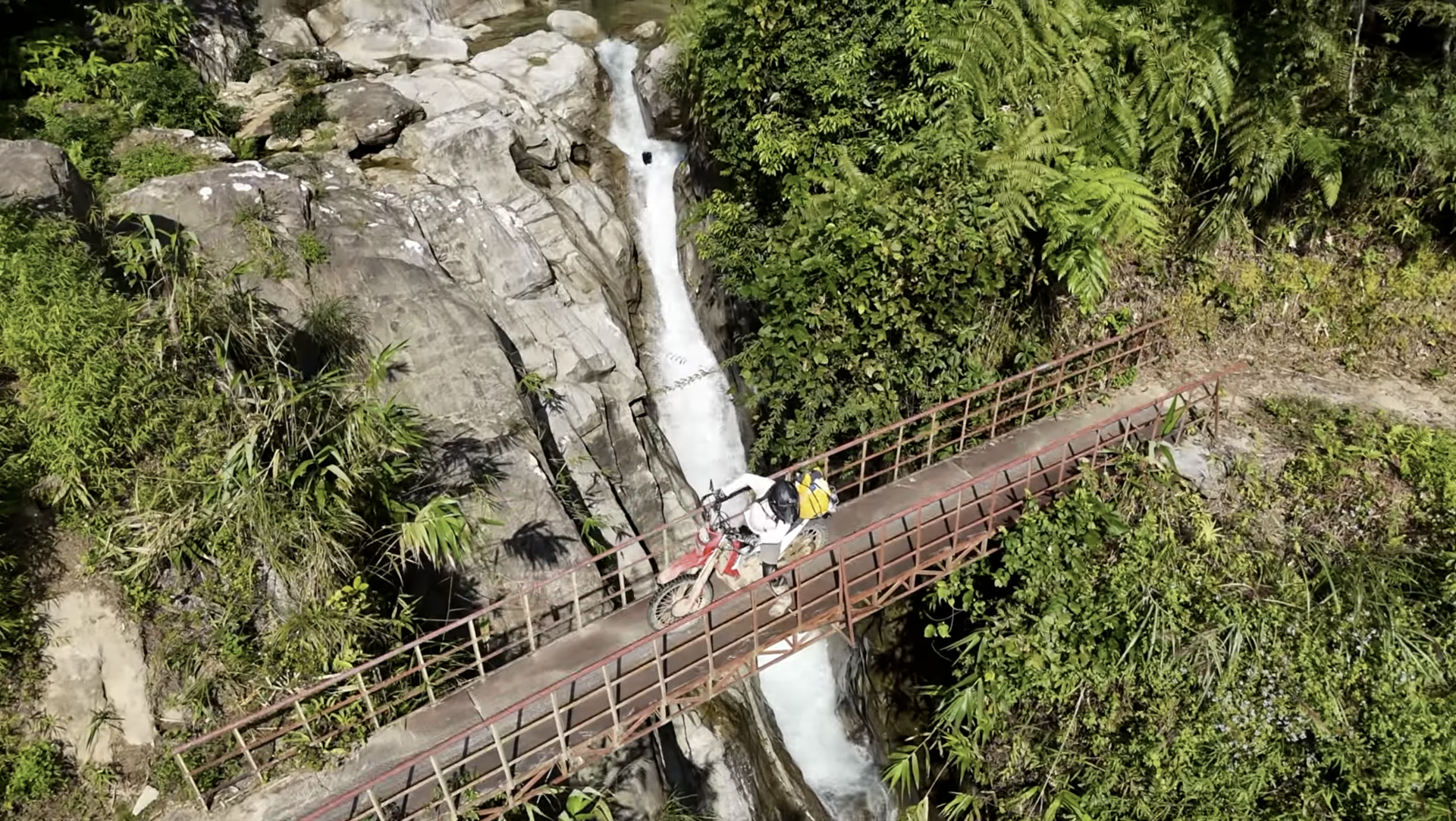
A suitable self-rider can start smoothly on an incline, brake progressively, select gears without looking down, complete tight turns and remain calm when the surface changes. Recent experience matters more than having ridden a motorcycle several years ago.
City riding provides useful traffic awareness, but it may not prepare someone for prolonged descents, gravel or exposed bends. Off-road experience helps on broken surfaces, although aggressive trail habits are inappropriate around local traffic and villages.
Before choosing to self-ride, test whether you can do the following:
- Stop firmly without locking a wheel or grabbing the brake.
- Ride slowly while maintaining balance and steering control.
- Start uphill without rolling backward into another vehicle.
- Select a safe cornering speed before entering the turn.
- Ride on gravel without abrupt braking or steering.
- Recognize fatigue and stop before control deteriorates.
If two or more of those actions are unfamiliar, take training before the trip or travel with an experienced driver.
Licensing and insurance are part of rider readiness
Physical ability does not make an unlicensed ride legal or insured. License recognition can depend on nationality, license class and the international permit convention under which a document was issued. Do not rely on a rental counter’s willingness to provide a motorcycle as proof that you can ride legally.
Check the current requirements with the appropriate Vietnamese authority, your license issuer and your insurer. The UK government’s Vietnam safety guidance illustrates why travelers must verify license validity, helmets and insurance rather than making assumptions based on other countries.
Confirm that your policy covers the motorcycle’s engine size and the activity itself. Medical coverage and vehicle damage coverage are separate issues. Read the exclusions.
The World Health Organization identifies speeding, helmets and post-crash care among the major factors affecting road traffic injury risk. On the loop, a properly fastened motorcycle helmet, protective gloves, long clothing and sturdy footwear are basic equipment, not optional touring accessories.
How a guided Ha Giang Loop tour reduces the workload
A guide cannot give a beginner motorcycle control by riding nearby. A properly planned guided tour does remove much of the route selection, timing and daily decision load, while a passenger option removes the riding task itself.
This is where a local operator’s value becomes visible. On a Cuong’s Motorbike Adventure tour, the useful process begins before departure rather than at the first mountain pass.
First, the rider gives an honest account of recent experience, license status, height, bike familiarity and comfort on loose surfaces. Saying that you have ridden scooters for two years is more useful than describing yourself as intermediate.
Next comes route and motorcycle selection. A traveler comfortable on a semi-automatic should not be pushed toward a taller manual motorcycle merely because it appears more capable. The chosen itinerary also needs realistic daily stages.
Before leaving, controls, luggage and protective equipment are checked. The rider needs to know the signals used by the group, the following-distance expectation and what to do after becoming separated. Practice happens before the road narrows.
During the ride, the guide sets a pace based on the slower competent rider, not the fastest person in the group. Stops are placed before difficult sections and after sustained concentration. If fog, rain or construction changes the route, the schedule changes with it.
At the end of each day, the next stage can be adjusted according to weather and rider fatigue. That feedback loop is valuable. A traveler who was comfortable on day one may be tired after the longer bends toward Dong Van, while another may improve once the controls become familiar.
Travelers comparing broader Vietnam motorcycle tour information and route ideas should look beyond destination lists. Ask how an operator evaluates ability, changes routes in bad weather, handles mechanical problems and responds when a rider no longer wants to continue.
Tour inclusions also affect practical support. The guide to Vietnam motorbike tour costs and inclusions explains why motorcycle condition, support, accommodation and what happens after a problem matter more than the headline price alone.
Common Ha Giang Loop difficulty mistakes
The most common error is choosing an itinerary from social media highlights. Scenic clips rarely show the wet descent, the truck around a blind bend or the final hour after concentration has faded.
Learning to ride during the tour
A flat practice area can introduce the controls. It cannot compress weeks of traffic, braking and cornering experience into a morning. Beginners sometimes improve quickly, but the public mountain road is still carrying buses, trucks, local riders and pedestrians while they learn.
Choose a passenger ride if you want the scenery without using the loop as a training course.
Copying another rider’s speed
Following a confident guide or friend can make a rider feel protected. It can also encourage entry speeds that exceed personal ability. Leave enough distance to choose your own line and brake independently.
The example rider’s gravel mistake occurred partly because attention shifted from the surface to the motorcycle ahead. A guide is a reference, not a substitute for observation.
Packing too much luggage
High or poorly secured luggage changes balance at low speed and during direction changes. It can also move under braking. Carry only what is needed for the loop, keep weight low and test the straps before each departure.
Do not hang loose bags from handlebars. They can interfere with steering or controls.
Treating the itinerary as fixed
A hotel reservation is not a reason to cross a pass in dangerous visibility. Keep room in the schedule, maintain communication with the next stop and accept that weather may remove an attraction or alter the overnight location.
For the four-day example, dropping an optional detour protects the daylight margin after rain. The route becomes less ambitious, but the trip remains enjoyable.
Underestimating the return day
Riders often relax too early once Ha Giang is within reach. Fatigue, familiar-looking pavement and the desire to finish can raise speed. Maintain the same spacing, corner entry discipline and rest schedule until the motorcycle is parked.
Should you self-ride, take a guided tour or ride as a passenger?
Self-riding suits licensed motorcyclists who have current road experience, reliable braking and gear control, and the judgment to change plans. It offers independence but leaves the rider responsible for navigation, bike checks, weather decisions and incident response. Going with a guide makes all the difference to explore and find the hidden locations for the Ha Giang Region, It can take 7-8 days to explore the NorthEast regions
A guided self-ride suits competent riders who want local route knowledge and less logistical work. It can also be valuable for experienced riders visiting Vietnam for the first time, since local traffic patterns and road conditions are unfamiliar.
A passenger tour is the practical choice for beginners, unlicensed travelers, nervous riders and anyone who wants to focus on the scenery. There is no meaningful loss of achievement in recognizing that the loop exceeds your current skill.
For the example rider with urban scooter experience, the decision depends on the pre-ride assessment. If slow control, semi-automatic shifting and hill starts are solid, a conservative guided self-ride may be reasonable. If those skills remain inconsistent, travel as a passenger.
Do not let a group’s plans determine your category. Select the option that remains appropriate in rain, not just the one that feels possible in a dry parking area.
Ha Giang Loop tour difficulty FAQ
Is the Ha Giang Loop suitable for beginners?
It is not a suitable place for a complete beginner to learn motorcycle control on public roads. A beginner can experience the route as a passenger with an experienced driver. Riders with limited experience should arrange a skills assessment rather than assuming that a guided group makes self-riding safe.
Is the Ha Giang Loop mostly paved?
Much of the standard route is paved, but that description can be misleading. Potholes, gravel, mud, repairs and construction can appear on otherwise paved roads. Conditions may change after heavy rain or maintenance work.
How many hours do you ride each day on the Ha Giang Loop?
Expect approximately four to seven hours on the road during a typical day, including stops. The exact time depends on the itinerary, weather, traffic, roadworks and group pace. Distance alone is a poor predictor because repeated mountain bends reduce average speed.
Is three days enough for the Ha Giang Loop?
No not for our Ha Giang Motorbike Tours, There are so many different places to visit it is best to take the time to realy explore. Three days can be enough for an experienced rider following a focused route in good conditions. Four days gives first-time visitors more room for viewpoints, rest and delays. Add flexibility rather than filling the extra day with more difficult roads.
Can I ride the Ha Giang Loop on a scooter?
Some riders use automatic scooters, but small wheels, suspension limits and reduced engine braking can make damaged surfaces and descents less comfortable. Motorcycle condition and rider competence matter more than the automatic label. Discuss the current route before deciding.
What is the hardest part of the Ha Giang Loop?
There is no single hardest section in all conditions. For one rider it may be the exposed bends around Ma Pi Leng. For another it will be a muddy construction zone, a foggy descent or the final hour of a long day. Weather can make an otherwise straightforward section the day’s main challenge.
Is a guided Ha Giang Loop tour safe?
A guide can improve route planning, pacing and response to changing conditions, but motorcycle travel always carries risk. A guided tour is not safe for a self-rider who lacks basic control. Choose a passenger option if you cannot meet the riding requirements.
What should I do if the weather becomes dangerous?
Stop somewhere fully clear of traffic, assess the forecast and seek local route information. Delay departure, shorten the day or change the route when visibility, flooding, landslide risk or surface conditions are unacceptable. Do not continue only because accommodation has already been booked.
The Ha Giang Loop is achievable for prepared riders, but it should be treated as a mountain motorcycle journey rather than a casual scooter outing. Competent riders can choose a guided self-ride or carefully planned independent trip. Beginners and travelers without valid riding credentials should choose a passenger tour and experience the same roads without carrying a task beyond their ability.


Related Motorbike Tours
Explore our most popular Vietnam motorbike tours, including guided on-road and off-road adventures through Ha Giang, Northwest Vietnam, Pu Luong, and the legendary Ho Chi Minh Trail. These tours are designed for riders looking for authentic routes, experienced support crews, and unforgettable mountain riding across Vietnam.