Northwest Vietnam Off-Road Ride Report – Eight Days Through Vietnam’s Wild Mountains
Some motorcycle trips are simply good holidays. You ride a few decent roads, take some photos, have a couple of beers and head home with another stamp in your passport.
Other trips become stories you will still be telling twenty years later.
Our eight-day Northwest Vietnam Off-Road Motorbike Tour with Cuong and his crew definitely belongs in the second category.
There were eight of us from New Zealand, all mates and experienced riders, although our riding backgrounds varied. Some had spent years racing and riding dirt bikes, while others had done more adventure touring, farm riding and long-distance gravel routes back home.
We had all heard stories about riding in Vietnam: steep mountains, wild traffic, tiny village tracks, river crossings, rice terraces and roads that could change completely after one tropical downpour.
That sounded like a bit of us.
We did not want to spend the trip following tourist buses along the main roads. We wanted to get into the backcountry, ride proper dirt and see the side of Vietnam that most visitors never reach.
That was how we ended up booking one of Cuong’s fully supported Vietnam off-road motorbike tours.
It turned out to be a bloody good decision.
Why We Chose Northwest Vietnam
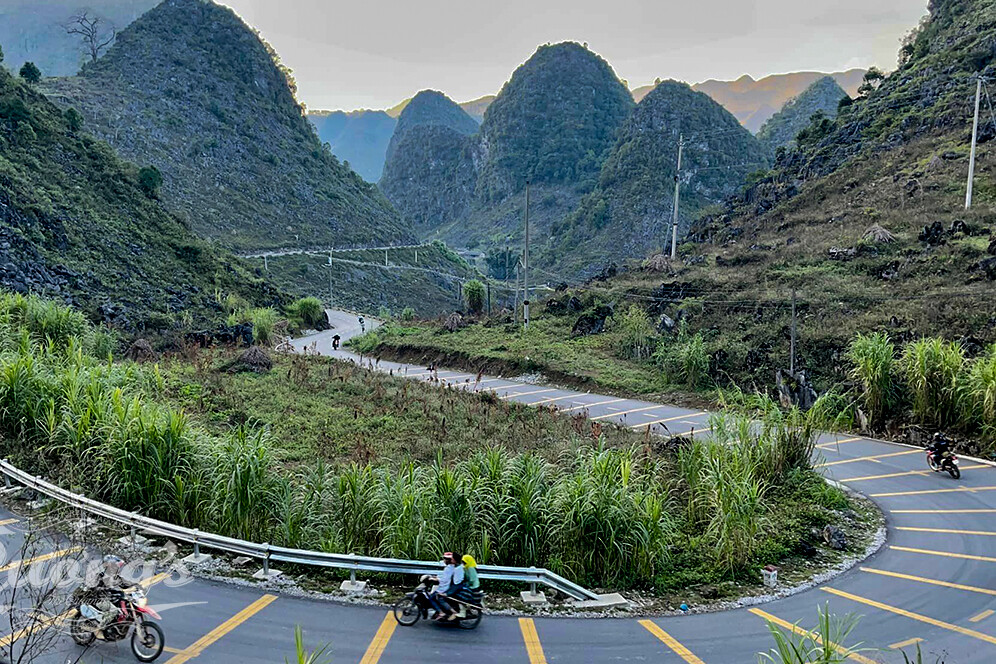
Before booking, most of us knew about Ha Giang. It appears everywhere online, with photos of giant limestone peaks and motorcycles parked above deep valleys.
Northwest Vietnam seemed different.
The region offered remote dirt trails, huge mountain ranges, terraced rice fields, forest tracks, tea-growing country and traditional ethnic minority villages. It also appeared far less developed as a motorcycle tourism destination.
We wanted to explore places such as Pu Luong, Mai Chau, Moc Chau, Tram Tau, Ngoc Chien, Mu Cang Chai and Sapa without being trapped in a procession of rented scooters.
Cuong’s Northwest Vietnam motorbike tours were exactly what we were looking for. The route travelled from Hanoi through the western mountains before finishing in Lao Cai, with the bikes and riders returning to Hanoi aboard the overnight train.
More importantly, the off-road version was built for experienced riders. This was not a scenic road tour with the occasional gravel shortcut. It promised dirt roads, jungle tracks, loose climbs, river crossings, mud, remote single track and long days in the saddle.
Sweet as.
Arriving in Hanoi and Meeting Cuong’s Crew
We arrived in Hanoi during the summer of 2026 and immediately discovered that the city operates at a completely different pace from anything back home.
Motorbikes flowed through the streets in every direction. Scooters carried families, boxes, furniture, building materials and loads that looked physically impossible. Horns sounded constantly, although nobody seemed angry. It was simply how everyone communicated.
Crossing the road on foot felt more dangerous than anything we expected to ride in the mountains.
The evening before departure, we met Cuong and the support crew, checked our equipment and went over the route. It became obvious very quickly that these guys knew exactly what they were doing.
Cuong has spent decades exploring and developing motorcycle routes across Vietnam. His team knew the mountains, the trails, the weather patterns and the villages along the way. They also understood how to manage a group of foreign riders with different speeds and riding styles.
There was no big sales pitch and no unnecessary drama. We talked through the route, discussed safety procedures, checked our gear and sorted the motorcycles.
Everything was organised.
That gave us a lot of confidence before the ride had even begun.
The Honda CRF300L – The Right Bike for the Job
Our main weapons for the ride were Honda CRF300L motorbikes.
The CRF300L is not a giant horsepower machine, but that is exactly why it works so well in the mountains of northern Vietnam. It is light, predictable, reliable and easy to control when the track becomes steep, slippery or narrow.
On some of the more technical sections, a heavier adventure bike would have been hard work. The Honda could be guided through rocks, mud and deep ruts without exhausting the rider.
It had enough power for the paved mountain roads but remained manageable when we needed to pick our way through a rough climb or paddle across a slippery stream.
The team also offered the Honda CRF250L, another proven machine for this type of terrain. Both models have the reliability needed for long rides through remote regions where the nearest proper workshop may be hours away.
Our bikes were well prepared, and the support crew carried tools and essential spares throughout the journey. With Cuong leading and the mechanic riding sweep behind us, nobody was left alone to deal with a problem.
All we needed to do was ride.
Day One – Hanoi to Pu Luong
There was no mucking around on the first morning.
We left Hanoi early, joining the flow of commuters as the city came to life around us. For the first section, the main objective was simply to escape the urban sprawl and get into the countryside.
Riding through Hanoi required concentration, but the traffic moved more naturally than it first appeared. Instead of expecting everyone to obey rigid lanes, you watched the flow, held a predictable line and moved with it.
Once we reached the edge of the city, the buildings began to thin out. The roads became quieter, the air felt fresher and the mountains slowly appeared ahead of us.
The transformation was remarkable.
One moment we were surrounded by buses, scooters and shopfronts. A short time later we were riding past rice paddies, small farming villages and green hills.
This was where the real Vietnam motorbike tour began.
Leaving the Main Roads Behind
After the first transport section, Cuong turned away from the larger road and led us onto a network of narrow country lanes.
The surface changed immediately.
Clean asphalt became broken concrete. Broken concrete became gravel. Gravel eventually became dirt.
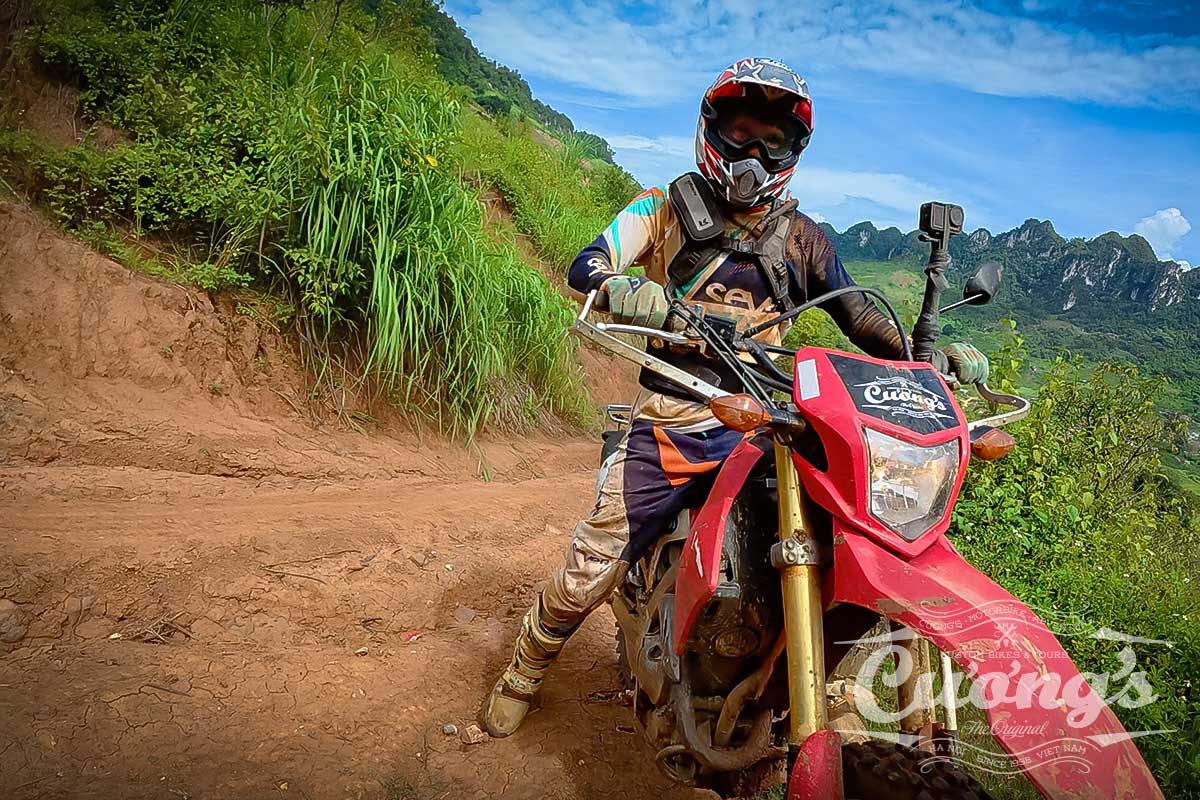
Everyone stood on the footpegs, loosened their grip and settled into the bikes.
Now we were smiling.
The route wound through low hills and farming communities, crossing small bridges and following tracks between fields. Local riders passed us on basic scooters, often wearing sandals and carrying enormous loads.
They made the rough roads look completely normal.
Whenever we stopped, people came over to look at the bikes. Children waved from the roadside, and farmers paused their work to watch eight foreigners rumble past in dusty riding gear.
There was none of the commercial atmosphere found in major tourism centres. These were working villages where visitors remained unusual.
Entering Pu Luong Nature Reserve
As we approached Pu Luong, the landscape became steeper and greener.
Forested limestone mountains rose above valleys filled with rice fields. Traditional wooden homes stood on stilts along the hillsides, surrounded by gardens, bamboo and small plots of farmland.
The road climbed higher before dropping into another hidden valley. Around almost every corner there was another view that made someone stop for a photo.
It was our first day, so we still believed we could photograph everything.
We soon learned that this was impossible in Northwest Vietnam.
The scenery never really stopped.
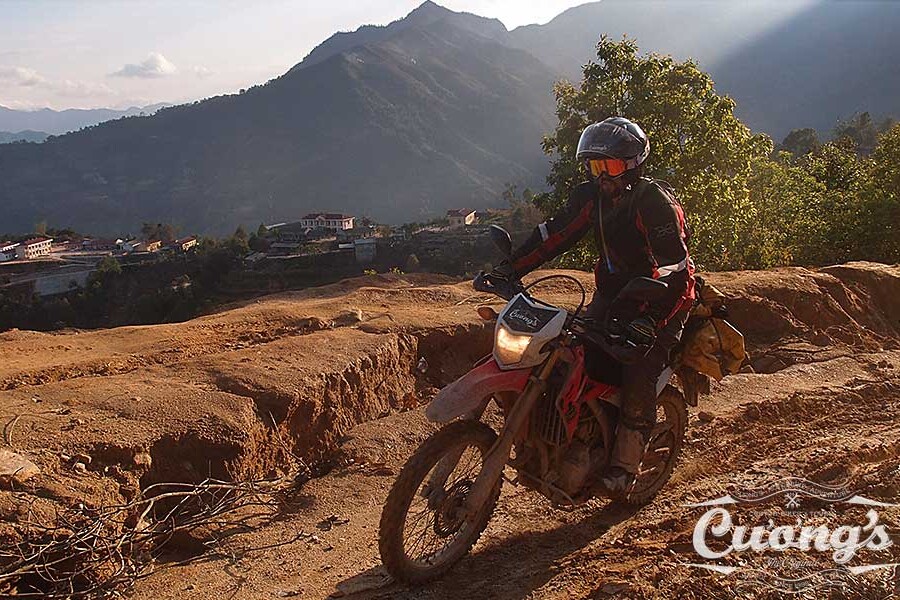
The afternoon included our first proper stretches of mountain dirt. Some sections were dry and flowing, allowing us to carry a comfortable rhythm. Others were rocky and rutted, forcing us to choose lines carefully.
Nothing was extreme yet, but it was enough to remind us that this was a genuine off-road ride.
By the time we reached our accommodation in Pu Luong, everyone was dusty, hungry and buzzing.
Our First Night in the Mountains
That evening set the pattern for the rest of the tour.
The bikes were checked while we cleaned up and changed. Luggage had already arrived, rooms were organised and cold drinks appeared without any fuss.
Dinner was a spread of local dishes served around a shared table: grilled meat, chicken, rice, fresh vegetables, spring rolls and several things we could not immediately identify but happily ate anyway.
The food was fresh, generous and full of flavour.
After dinner, a bottle of local rice wine appeared.
Then another one.
Cuong explained more about the region and what we could expect over the next few days. There was plenty of banter as we replayed every loose corner, missed line and near-disaster from the day.
Nobody had actually fallen off yet, although a few blokes had already experienced what we politely called “moments.”
We went to bed knowing the easy introduction was probably over.
Day Two – Pu Luong to Mai Chau and Moc Chau
The next morning began with mist hanging over the valley.
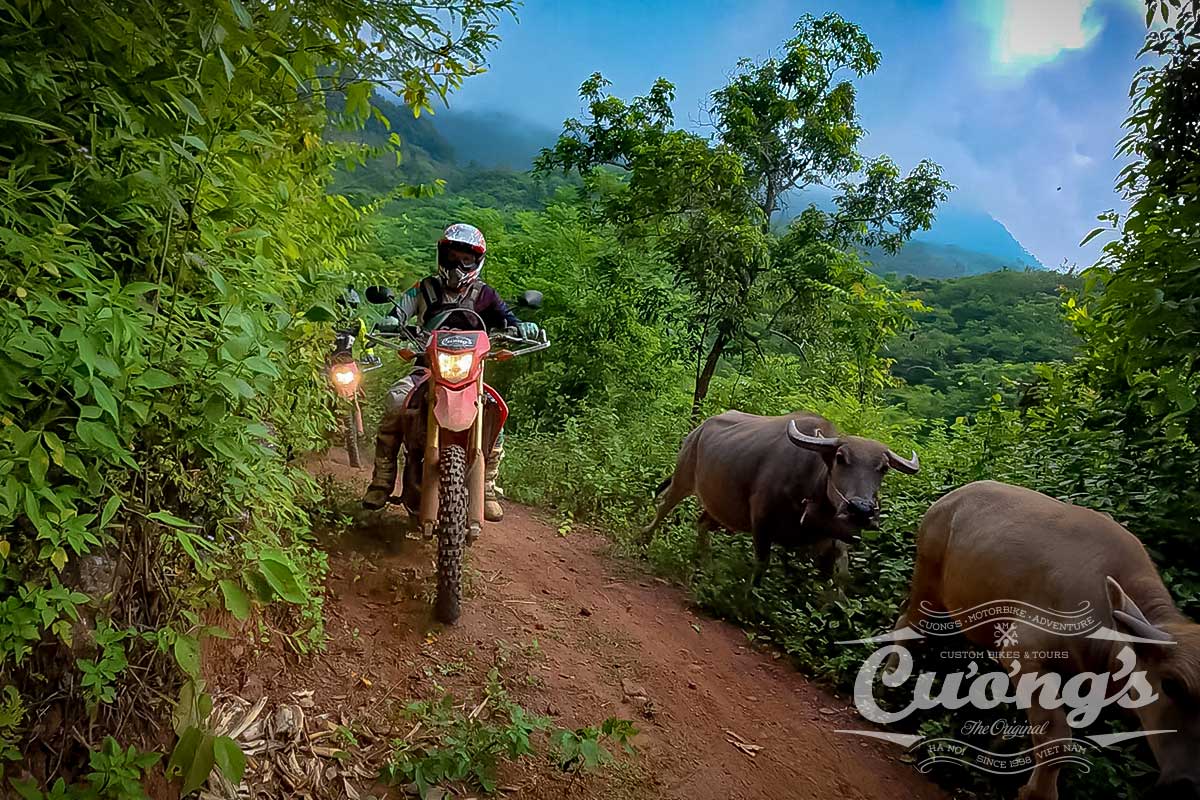
From our accommodation, we could see layers of green mountains fading into the distance. Smoke rose from village kitchens while farmers and buffalo were already moving through the fields.
After breakfast, the team checked tyre pressures, chains and controls before we loaded up and headed back onto the trails.
The air was cool, the dirt had a little moisture in it and the bikes felt brilliant.
Riding Through Remote Thai and Muong Villages
The route between Pu Luong and Mai Chau passed through communities of Thai and Muong people who have lived in these valleys for generations.
Traditional stilt houses lined the tracks, often with livestock sheltering beneath the raised living areas. Rice, corn and other crops were spread out to dry beside the road.
The villages were connected by narrow lanes, suspension bridges and mountain tracks that twisted between forest and farmland.
Some sections were barely wider than the motorcycles.
One moment we were riding through dense bamboo. The next we emerged onto an open hillside with views across a huge valley of terraced fields.
This was the type of riding we had travelled for.
There were no buses and no queues at viewpoints. For long stretches, the only people we saw were local farmers and children walking home from school.
When we stopped for drinks, curious locals gathered around the motorcycles. There was usually no common language, but that never seemed to matter.
A smile, a handshake and some enthusiastic pointing at the bikes did most of the work.
Mai Chau Valley
We descended into Mai Chau around midday.
The valley was broader than Pu Luong, with rice fields spreading between steep mountains on both sides. Villages sat among the farmland, their roofs visible between palms and fruit trees.
Mai Chau is accessible from Hanoi and appears on many short northern Vietnam itineraries, but Cuong’s route did not simply follow the standard tourist road.
We used the valley as a gateway into a much larger network of western mountain tracks.
After lunch, the riding changed again as we began climbing towards the highlands of Moc Chau.
The Climb Toward Moc Chau
The road rose steadily from the valley floor, passing through cooler air and increasingly dramatic terrain.
There were fast paved corners where we could enjoy the handling of the CRFs, followed by abrupt turns onto dirt roads that disappeared into the hills.
The surface varied constantly.
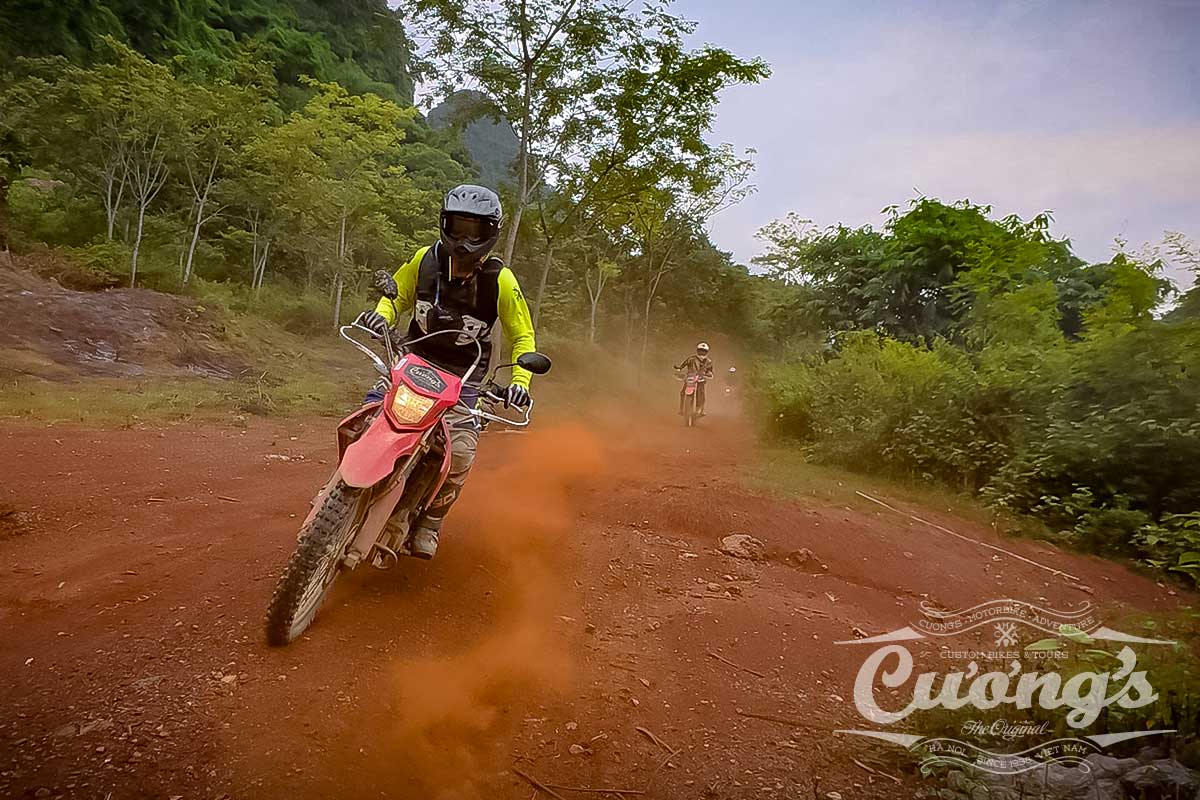
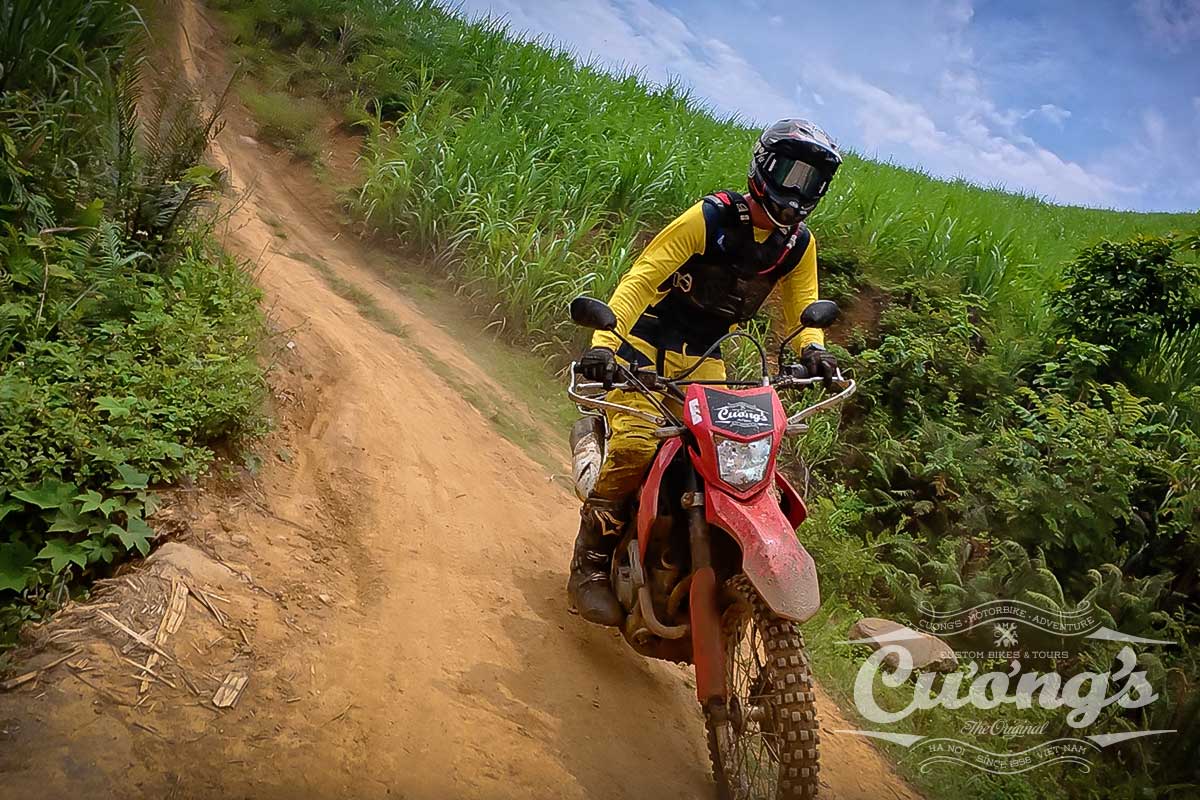
We rode over loose stones, dry clay, broken concrete and hard-packed earth. Water had cut channels through some sections, creating deep ruts that demanded full attention.
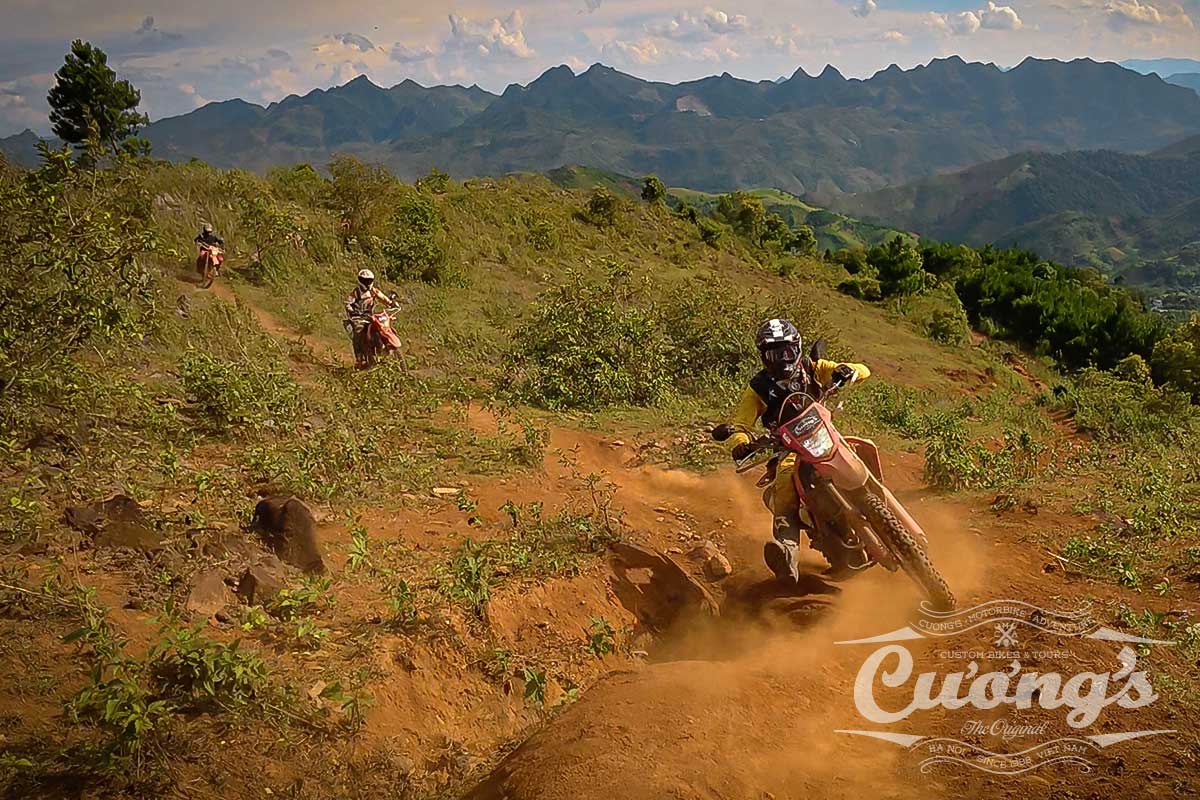
On the steeper climbs, we spread out to avoid filling each other’s helmets with dust.
The trick was to maintain momentum without charging blindly into whatever waited around the next corner.
Most of the time, that worked.
One rider stalled halfway up a rough climb and began sliding backwards. Another took the enthusiastic approach to a rut and disappeared briefly into the vegetation.
No injuries, no damaged bikes and no shortage of abuse from the rest of us.
Standard procedure among Kiwi mates.
Day Three – Exploring Moc Chau’s Mountain Tracks
Moc Chau felt completely different from Pu Luong and Mai Chau.
The elevation brought cooler temperatures, while rolling hills replaced some of the sharper limestone scenery. The region is famous for agriculture, orchards, dairy farms and vast tea plantations.
From a distance, the rows of tea plants created flowing patterns across the hills.
It was peaceful, green and surprisingly open after the tight forest tracks of the previous day.
That did not mean the riding became easy.
Tea Plantations and Hidden Dirt Roads
We began the day on narrow roads through the tea-growing country before Cuong turned onto another barely visible track.
This became a regular feature of the ride.
We would be travelling along an obvious road when Cuong suddenly indicated, slowed down and disappeared through a gap between houses or into a line of trees.
What looked like a farm entrance often became an excellent off-road route across the mountains.
The Moc Chau trails included flowing red dirt, rocky climbs and narrow paths between plantations. Some sections allowed us to ride quickly and smoothly, while others became slower and more technical.
The weather also began to play a larger role.
Summer rain had left water in shaded sections, turning the red soil into slippery clay. A trail that looked straightforward could suddenly become greasy enough to send both wheels sideways.
The CRF300Ls handled it well, but only when treated with respect.
Too much throttle and the rear wheel spun. Too little momentum and the bike stopped halfway through the mud.
Finding the balance was part of the fun.
The Support Crew Kept Everything Moving
By the third day, we had developed a huge appreciation for the support crew.
The mechanic rode at the back, making sure nobody became separated from the group. If a bike was dropped, damaged or needed an adjustment, help arrived immediately.
The luggage travelled separately, meaning we did not have to wrestle loaded motorcycles through technical terrain. We carried only what we needed during the day and found our bags waiting when we reached the accommodation.
Fuel stops, meals and overnight arrangements were all planned around the route.
It allowed us to focus entirely on riding.
This level of organisation is what separates a professionally supported expedition from simply renting a bike and hoping for the best.
On remote trails in Northwest Vietnam, local knowledge matters. Tracks can be blocked by landslides, bridges can disappear, and summer weather can make a planned route temporarily impassable.
Cuong and his crew always had another option.
They had spent years exploring these mountains and refining the routes. When conditions changed, the plan changed with them.
Three Days In and Already Hooked
By the end of our third day, the group had settled into a comfortable rhythm.
We knew who liked to ride near the front, who preferred a steady pace and who could be relied upon to attempt the least sensible line through any obstacle.
Each evening followed a similar pattern: clean up, grab a cold beer, inspect any new bruises and gather around the dinner table.
The food remained outstanding, with each area introducing different local dishes. Accommodation ranged from comfortable guesthouses to traditional homestays, but it was always clean and welcoming.
We had already ridden through tropical forest, rice-growing valleys, ethnic minority villages and highland tea country.
Yet Cuong kept telling us the biggest mountains and best riding were still ahead.
From Moc Chau, our route would continue deeper into Northwest Vietnam toward Tram Tau, Ngoc Chien and the legendary rice terraces of Mu Cang Chai.
That was where the ride was about to become properly wild.
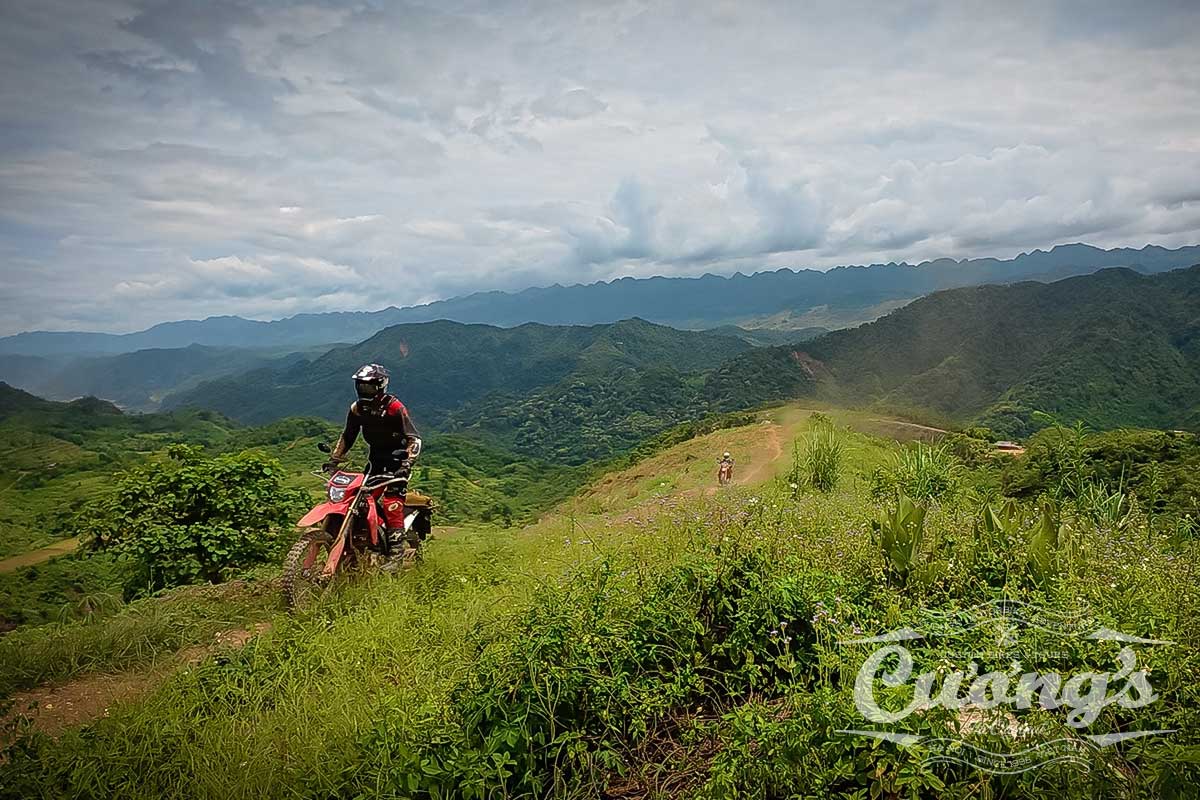
Day Four – Moc Chau to Tram Tau
Leaving Moc Chau, we knew the ride was about to step up another level.
The first three days had given us a solid introduction to riding in Northwest Vietnam, but the route toward Tram Tau took us farther away from the larger roads and deeper into the mountains.
Cuong had warned us that this would be a longer and more demanding day.
The morning started gently enough, with cool air, quiet mountain roads and sweeping views across Moc Chau’s farmland. Rows of tea plants followed the curves of the hills, and mist still hung in some of the lower valleys.
It would have been easy to settle into sightseeing mode.
Then Cuong turned off the road.
Within minutes, we were back on narrow dirt tracks, climbing through forest and farmland toward another remote mountain ridge.
From Fast Dirt to Technical Mountain Trails
The early sections were fast and flowing.
The surface was mostly firm, with enough loose gravel to keep the bikes moving underneath us. We spread out along the trail and found a good rhythm, standing on the footpegs and letting the Honda CRF300Ls work beneath us.
This was adventure riding at its best.
The track rose and fell through the hills, crossing streams and passing isolated farms. There was almost no traffic, apart from the occasional local scooter or small farm vehicle.
As the morning continued, the trails became narrower and rougher.
Deep rain channels cut across the track. Loose rocks collected on the steeper climbs, and sections of red clay remained slippery beneath the trees.
The riding required full concentration.
Every obstacle was manageable, but there was no room for switching off. A smooth line could carry you easily through a difficult section, while one badly placed front wheel could leave you fighting the bike in a rut.
There was a bit of friendly competition among our group, although nobody admitted it.
Every rider wanted to clear the climbs cleanly, especially when the rest of the boys were waiting at the top.
Nothing motivates a Kiwi rider quite like the knowledge that seven mates are watching and ready to take the mickey if it all goes wrong.
The First Proper Mud
Summer weather in Northwest Vietnam can transform a trail remarkably quickly.
A dry-looking track might remain firm in the open but become completely different beneath the trees, where water collected in the ruts and the clay stayed wet.
One section looked harmless from a distance.
It was not.
The first rider entered confidently, only for both wheels to begin sliding in different directions. He somehow kept the bike upright, although not with any dignity.
The rest of us stopped and reconsidered our approach.
The safest line ran along the edge of the track, but it was narrow and bordered by thick vegetation. The middle offered more space but contained deep, slippery mud.
One by one, we picked our way through.
Some made it cleanly.
Some used both feet.
One rider arrived at the other side wearing a generous portion of the trail.
It was the first proper mud of the trip, and it would not be the last.
Why the CRF300L Worked So Well
The more technical the trail became, the more we appreciated the motorcycles.
The Honda CRF300L was light enough to correct when it began sliding, but stable enough to handle rocky descents and faster open tracks.
The power delivery was smooth and predictable, which mattered when traction disappeared.
A larger, heavier motorcycle might have been comfortable on the paved sections, but it would have been a completely different story in deep ruts or on narrow mountain trails.
The CRFs could be lifted, pushed or turned around without turning every small mistake into a major recovery operation.
That made the ride more enjoyable and allowed us to tackle genuine off-road routes instead of being restricted to roads suitable for large adventure bikes.
Arriving in Tram Tau
By the time we approached Tram Tau, everyone was feeling the day in their arms and shoulders.
The district sits among steep mountains in western Yen Bai Province and remains far less visited than Vietnam’s better-known northern destinations.
That isolation was obvious.
The roads were quiet, settlements were scattered, and the surrounding mountains seemed to continue forever.
We arrived dusty and tired but completely satisfied.
It had been a proper day on the bikes.
After the usual checks, we cleaned up and gathered for dinner. The conversation quickly became a detailed analysis of every muddy section and rocky climb.
As usual, everyone remembered their own riding as being slightly more impressive than it probably was.
Day Five – Tram Tau to Ngoc Chien
The ride from Tram Tau to Ngoc Chien became one of the most memorable days of our entire Northwest Vietnam Off-Road Tour.
The landscape felt increasingly remote, and the trail network seemed to disappear deeper into the mountains with every kilometre.
We began with a mixture of broken roads and dirt tracks, climbing steadily through forests and highland villages.
The air became cooler as we gained elevation.
Cloud drifted across the ridges, sometimes hiding the mountains completely before clearing to reveal enormous valleys below us.
High Mountain Riding
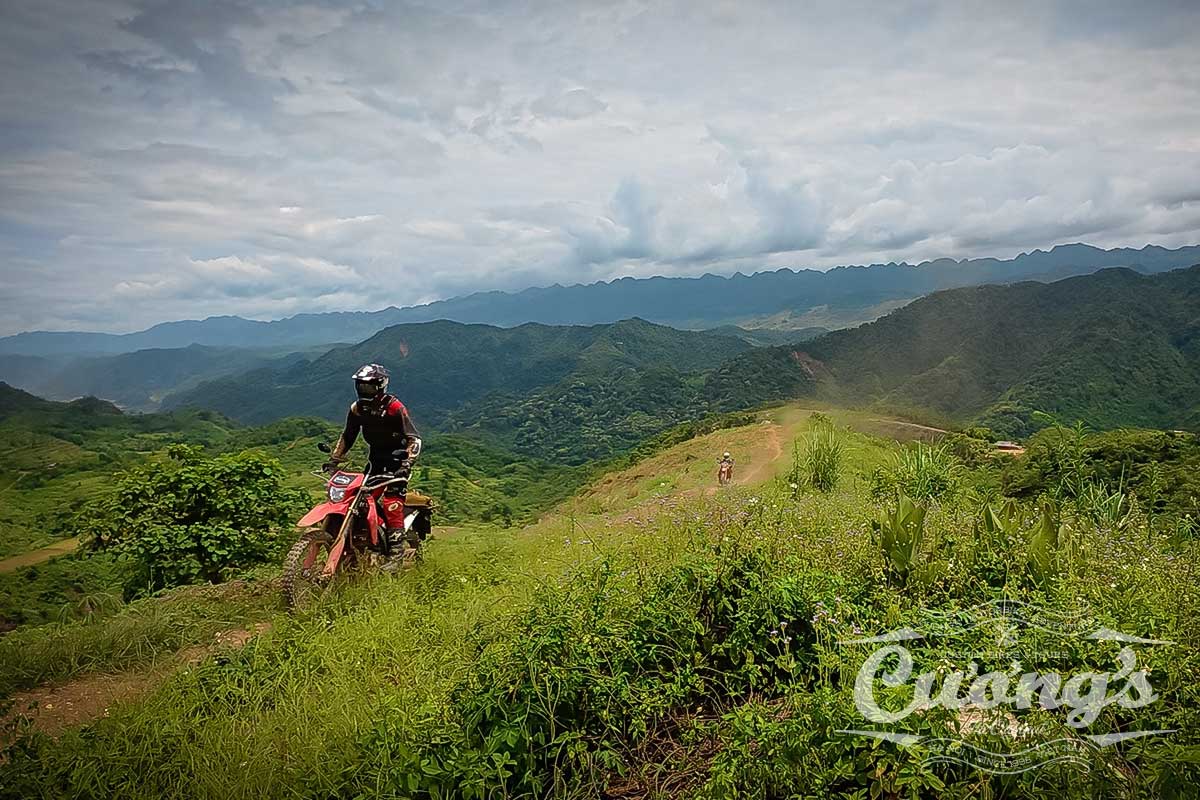
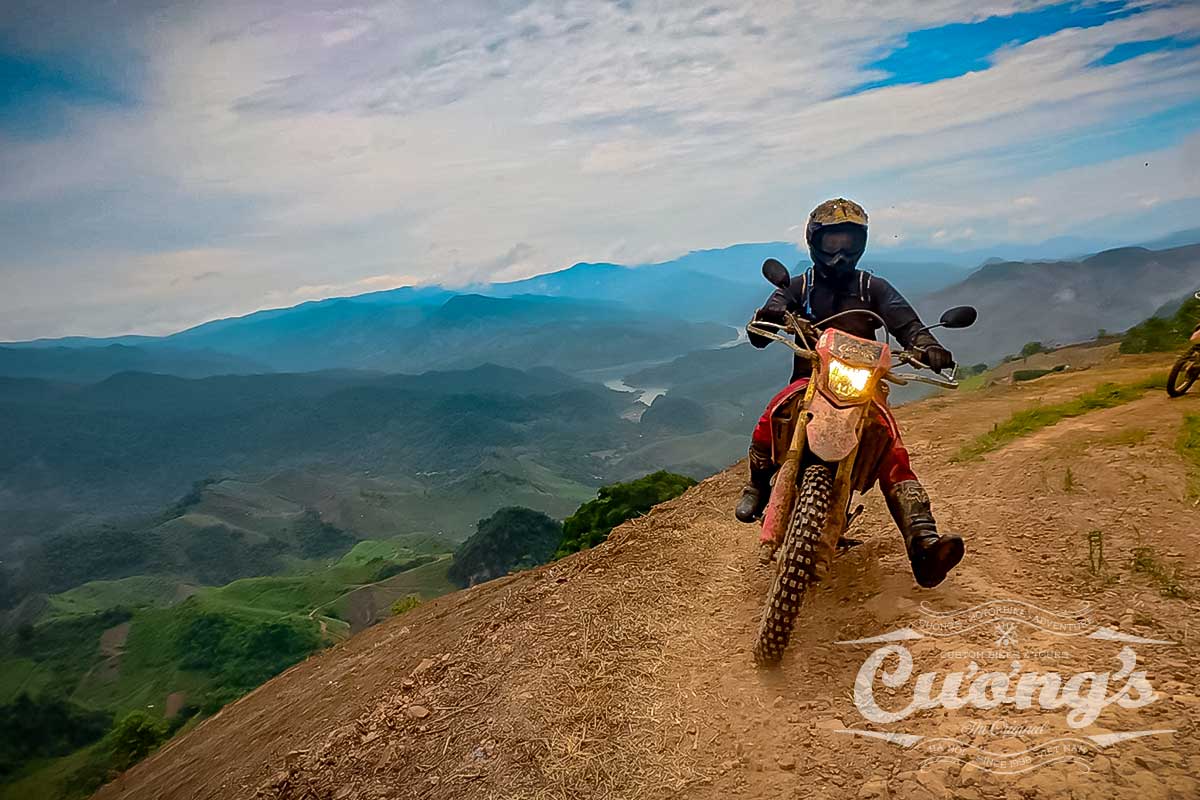
Some of the higher tracks followed exposed slopes with clear views across the surrounding ranges.
There were no barriers and very little room for error, so this was not the place for heroics.
We rode at a controlled pace, leaving space between the bikes and concentrating on the trail ahead.
The scale of the landscape was difficult to understand until we stopped.
From the saddle, you focus on the next corner, rut or obstacle. Once the engines were switched off, we could see layers of mountains stretching toward the horizon.
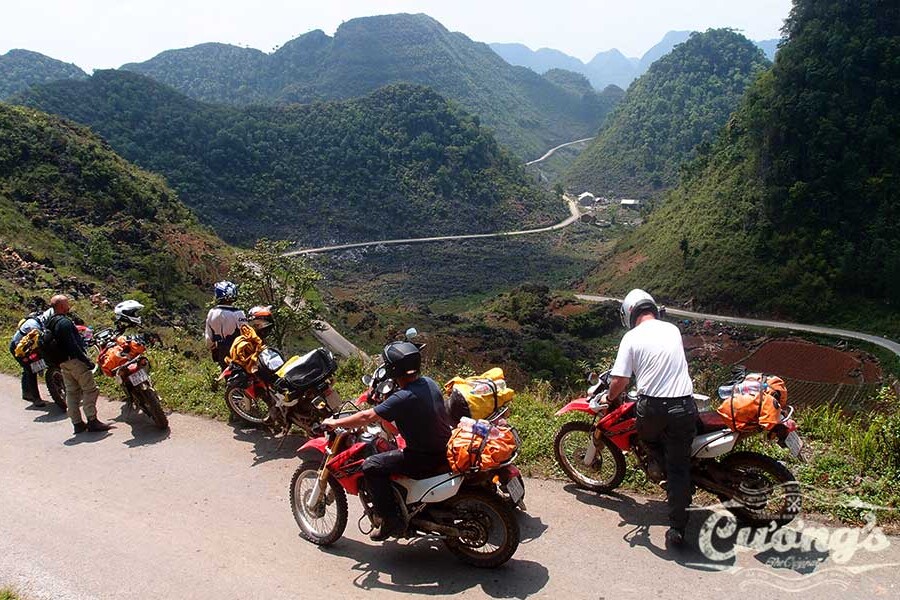
Tiny villages sat far below us, connected by roads and paths that looked like thin lines drawn across the hillsides.
Back home, a road like this would probably have become a famous adventure route.
Here, it was simply how local people travelled between communities.
Meeting Local Riders on the Trail
One of the humbling parts of riding in Northwest Vietnam was seeing local people travel over difficult terrain on ordinary scooters.
We had proper off-road motorcycles, protective equipment, experienced guides and a mechanic.
Local farmers rode the same tracks on small scooters while carrying crops, tools, children and sometimes several live animals.
They rarely seemed bothered by mud, rocks or steep slopes.
On one narrow climb, we stopped to allow a local rider to pass. His scooter was loaded with sacks and looked completely unsuitable for the terrain.
He gave us a quick smile and rode straight up without putting a foot down.
That kept us humble.
Crossing Streams and Mountain Rivers
The route included several small water crossings where mountain streams cut across the trail.
Most were shallow, but the bottoms varied between loose stones, smooth rocks and soft mud.
Cuong crossed first and stopped on the far side to guide us toward the safest line.
The key was to enter steadily, remain relaxed and avoid sudden changes of direction.
That was the theory.
In practice, eight riders produced eight different techniques.
Some stood on the pegs and crossed smoothly.
Some sat down and paddled.
One rider attacked the crossing as if competing in an enduro, sending water over both himself and everyone standing nearby.
The crew had seen it all before.
They simply smiled and kept us moving.
A Remote Lunch Stop
Lunch was often served in small local restaurants that we would never have found on our own.
There was no printed menu in English and usually no obvious sign outside.
Cuong knew where to stop, what to order and how to make sure eight hungry riders were properly fed.
Meals usually included rice, pork or chicken, vegetables, soup and several shared dishes placed in the middle of the table.
The food was simple, fresh and exactly what we needed during long riding days.
There was never any danger of going hungry on this trip.
In fact, despite riding for six to eight hours most days, some of us suspected we might be gaining weight.
Descending Into Ngoc Chien
The final descent into Ngoc Chien was spectacular.
The valley appeared beneath us as the track dropped from the high mountains through forest and farmland.
Ngoc Chien is known for its traditional villages, terraced fields and natural hot springs. Wooden stilt houses are spread across the valley, surrounded by rice paddies and mountains.
After a demanding day on the motorcycles, the hot water was exactly what our backs and shoulders needed.
We soaked, drank cold beers and replayed the day’s events while the evening settled over the valley.
It was hard to imagine a better finish to a day of off-road riding.
Day Six – Ngoc Chien to Mu Cang Chai
By Day Six, our group was completely settled into mountain-riding mode.
We woke early, ate breakfast and prepared for another long day without needing much explanation.
The bikes were checked, water bottles filled and riding gear pulled back on while the village came to life around us.
The route toward Mu Cang Chai promised some of the most famous scenery in Northwest Vietnam, but Cuong made sure we reached it by the interesting way.
Rather than following only the main road, we linked together remote trails, small mountain passes and village tracks.
Riding Above the Black River Region
Northwest Vietnam is shaped by major rivers, deep valleys and steep mountain systems.
The Black River, known locally as the Da River, cuts through the western mountains and plays an important role in the life of the region.
Throughout the ride, we crossed tributaries, followed river valleys and climbed above landscapes carved by water over thousands of years.
Some of Cuong’s shorter western routes also explore this part of the country, including the Western Vietnam Motorbike Tour.
Our longer Northwest expedition continued farther north, carrying us toward the high rice-growing mountains around Mu Cang Chai.
Trails Through Hmong Villages
As we climbed, we passed through villages inhabited mainly by Hmong families.
Homes were built beside the tracks or scattered across the hillsides, often surrounded by cornfields and small gardens.
Children waved and called out as we approached.
Some recognised the sound of Cuong’s group before they could see us and ran toward the road to watch the motorcycles pass.
We always slowed through villages.
Livestock, children and farm vehicles could appear without warning, and the route was part of everyday local life rather than a private riding trail.
Respecting the communities was an important part of the journey.
Cuong had built relationships across these areas over many years, and it showed in the way people greeted him along the route.
A Proper Mountain Climb
The most difficult section of the day began with a steep dirt climb that disappeared around several tight corners.
The surface contained loose rocks, exposed roots and deep channels formed by rainwater.
Cuong stopped the group at the bottom and explained the line.
Momentum was essential, but too much speed would make the tight corners difficult. We needed to stay loose, look ahead and avoid spinning the rear wheel.
Easy enough when someone explains it.
A little more complicated when you are halfway up.
The first riders cleared the climb, although not always using the planned line. The middle of the group had a few stalls and restarts, while the final riders benefited from watching everyone else’s mistakes.
The mechanic remained at the back, helping wherever needed.
When the final bike reached the top, there was a fair bit of cheering.
It was one of those sections that brought the whole group together.
Nobody cared who had been fastest. Getting all eight riders and bikes safely to the top was the win.
Mu Cang Chai – Mountains Carved Into Rice Terraces
Our first view of Mu Cang Chai stopped the entire group.
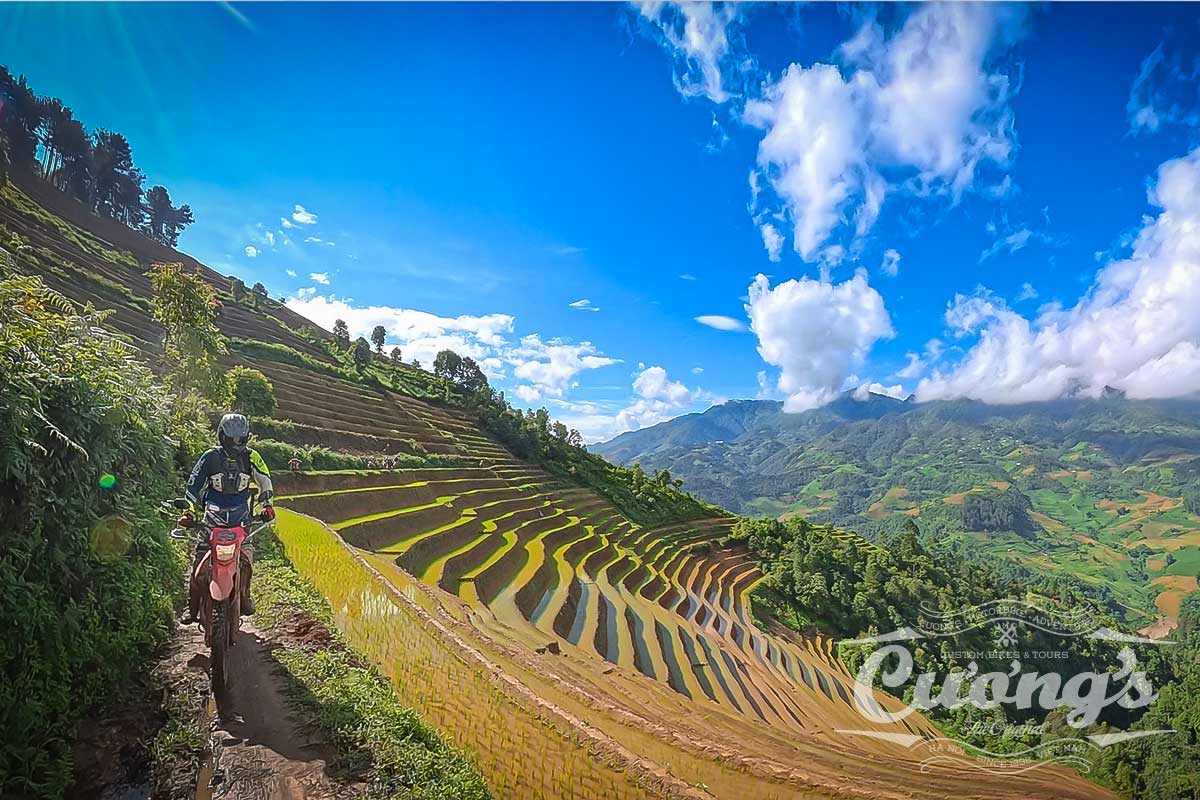
Terraced rice fields covered the slopes from the valley floor to the upper mountains, following every natural contour of the land.
The scale was extraordinary.
These were not a few decorative fields beside a viewpoint. Entire mountains had been shaped by generations of farmers.
The terraces curved around the hills like giant steps, changing colour and appearance with the seasons.
During summer, the landscape was intensely green. Water reflected the sky in newly planted sections, while more mature rice moved gently in the wind.
We parked the bikes and stood quietly for a while.
Even the loudest members of our group ran out of words.
Riding Through the Rice Terraces
The best part was that we did not only view the terraces from the main road.
Cuong led us onto small tracks that climbed through the fields and connected isolated villages.
The riding was slow in places because the paths were narrow and used by local farmers.
There were sharp turns, steep drops and occasional sections where the track had partially collapsed after rain.
We rode carefully, stopping often to take in the scenery.
Every change in elevation created another view.
From below, the terraces towered above us. From the higher tracks, we could look across whole valleys shaped into layers of green.
It was one of the most remarkable landscapes any of us had ever ridden through.
Why Northwest Vietnam Felt So Different
Before the trip, several of us had assumed that northern Vietnam would look broadly similar from one region to another.
We could not have been more wrong.
Pu Luong had lush limestone valleys and stilt-house villages.
Mai Chau offered broad rice fields surrounded by mountains.
Moc Chau brought tea plantations and cooler highland scenery.
Tram Tau felt rugged and isolated.
Ngoc Chien combined remote trails with traditional villages and hot springs.
Now Mu Cang Chai presented huge mountains covered in rice terraces.
This variety is what makes the Northwest Vietnam motorbike tour region so rewarding.
The scenery, riding surface and local culture changed almost every day.
It never felt repetitive.
Another Brilliant Evening
That evening, everyone was tired but in excellent spirits.
We had completed one of the strongest riding days of the trip and arrived in one of Vietnam’s most beautiful mountain regions.
The crew checked the motorcycles while we showered and changed.
Dinner arrived as another large collection of shared dishes, followed by local rice wine and plenty of stories.
By now, a few minor crashes had occurred, although nothing serious.
Every incident grew more dramatic with each retelling.
A simple stationary drop became a high-speed escape from disaster.
A missed turn became an expedition into an unexplored valley.
A muddy boot became evidence of heroic off-road struggle.
That is how ride reports are created.
Six Days Into the Ride
After six days, the motorcycles were dusty, our riding gear had developed its own personality and nobody wanted the trip to end.
We had travelled far beyond the usual tourist routes and experienced the kind of riding that had brought us to Vietnam in the first place.
The combination of proper off-road terrain and professional support made the journey challenging without becoming chaotic.
Cuong adjusted the pace to suit the group and changed sections when weather or trail conditions required it. The mechanic kept the bikes operating perfectly, and the wider crew made sure meals, accommodation and luggage were always ready.
That support allowed us to push into remote areas with confidence.
We still had to ride the tracks ourselves.
We still became tired, muddy and occasionally stuck.
But we never felt abandoned or badly prepared.
That distinction matters on a serious Vietnam off-road motorcycle adventure.
From Mu Cang Chai, the final stage of our journey would take us toward the Hoang Lien Son mountains, Sapa and the border city of Lao Cai.
The highest passes, enormous valleys and final technical trails were still waiting.
And none of us was ready to slow down.
Day Seven – Mu Cang Chai to Sapa
We woke in Mu Cang Chai knowing that our final full riding days would take us into the biggest mountains of the trip.
The Hoang Lien Son range rises across Northwest Vietnam and contains some of the country’s highest peaks, deepest valleys and most spectacular mountain roads.
Our destination was Sapa, but Cuong had no intention of taking us there by the quickest or easiest route.
That suited us perfectly.
After breakfast, the crew completed the usual checks on the motorcycles. Chains were adjusted, tyres inspected and fuel organised while we packed our riding gear.
The morning air was cool, and low cloud still clung to the mountains surrounding Mu Cang Chai.
We rolled out through the rice terraces as villages began waking around us.
Farmers were already working in the fields, children were heading toward school and smoke drifted from cooking fires beside traditional homes.
It was another reminder that the extraordinary landscapes we had come to explore were also working environments where local families lived their everyday lives.
Leaving the Rice Terraces Behind
The first section of the day continued through the terraced mountains around Mu Cang Chai.
We followed narrow roads and village tracks that climbed above the valley, giving us one final view across the layered rice fields.
Even after spending the previous day in the region, the scenery remained difficult to take in.
Every slope seemed to have been shaped into terraces. Houses appeared in places that looked almost impossible to reach, connected by tiny tracks carved into the mountainsides.
From Mu Cang Chai, our route began climbing toward higher passes and more exposed terrain.
The landscape gradually changed as the valleys became deeper and the mountains more dramatic.
Forest covered the lower slopes, while cloud moved quickly across the ridges above us.
The riding alternated between winding paved roads, broken mountain lanes and long off-road sections.
By now, we had become used to the constant changes in surface.
We could move from clean asphalt to loose gravel, mud and rocky single track within a few kilometres.
That variety was one of the best features of the entire Northwest Vietnam Off-Road Motorbike Tour.
Riding Through the Hoang Lien Son Mountains
The Hoang Lien Son mountains delivered some of the most dramatic riding of the trip.
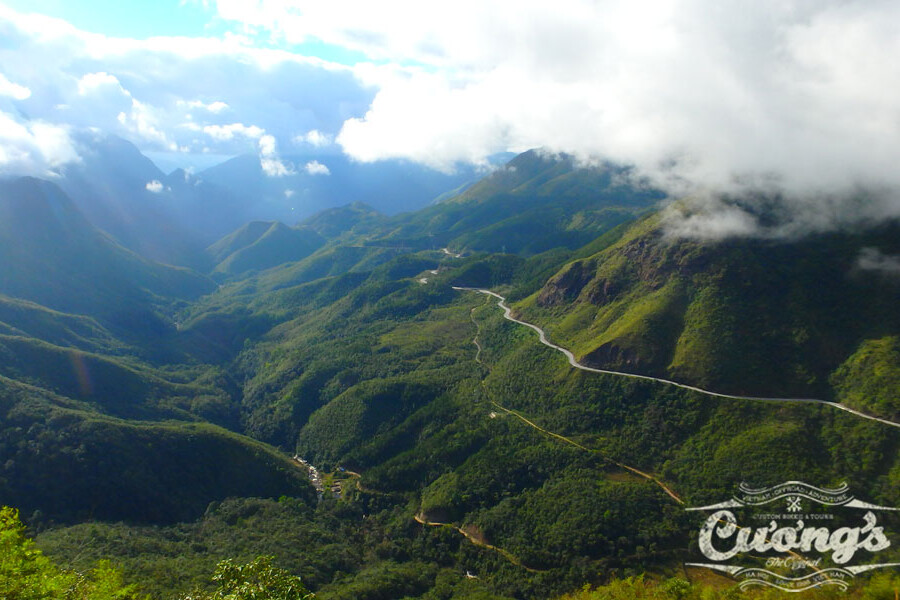
The roads climbed high above deep river valleys, twisting through forests and around enormous mountainsides.
Waterfalls dropped from cliffs beside the road, fed by the summer rain and cloud that gathered around the peaks.
In some places, the view stretched for kilometres.
In others, the cloud closed around us and reduced visibility to the next few corners.
The temperature also dropped as we gained altitude.
After the heat and humidity of the lower valleys, the cool mountain air felt brilliant inside our riding gear.
We stopped at one exposed viewpoint and switched off the engines.
Far below us, a river wound through the valley. Villages appeared as small clusters of roofs among the fields, and mountain ridges continued into the distance.
None of us said much for a while.
There are some places where taking another photograph seems almost pointless.
You simply stand there and try to remember the scale of it.
One Final Technical Trail
Cuong had saved another proper off-road section for the afternoon.
The trail began as a wide dirt road before narrowing as it climbed through forest.
Recent rain had left the surface damp, with loose stones and exposed roots appearing on the steeper sections.
After seven days of riding, everyone was tired, but we had also become much more comfortable on the bikes.
The group moved smoothly through the easier sections, maintaining enough distance to avoid dust and leave room for mistakes.
The trail then entered a shaded area where the surface became greasy.
The red clay offered almost no grip in places.
The front wheel wanted to slide toward the deeper ruts, while the rear wheel stepped sideways whenever too much throttle was applied.
It required patience rather than speed.
Cuong rode ahead and waited at the more difficult corners, showing us the best line.
The mechanic remained behind the final rider, helping whenever a bike stalled or became stuck.
One of the boys dropped his bike at walking pace and immediately stood up pretending nothing had happened.
Unfortunately for him, seven witnesses had seen the whole thing.
There was no injury and barely a mark on the Honda, but the story was guaranteed to grow considerably by dinner.
The Difference Between a Tour and an Expedition
That final technical section showed why local knowledge and professional support mattered so much.
Anyone can follow a major road toward Sapa.
Finding a network of remote dirt trails through the mountains is completely different.
Weather, construction work and landslides can change conditions quickly. A route that worked the previous month may no longer be passable after heavy rain.
Cuong and his crew knew where the trails went, which sections remained open and when it was better to use an alternative route.
That flexibility made the ride feel like a genuine expedition without becoming disorganised.
We still had to deal with rocks, mud, fatigue and difficult climbs, but the wider logistics had been handled for us.
Meals were ready.
Accommodation was organised.
Luggage arrived ahead of the riders.
Mechanical support remained with the group.
It was the ideal setup for experienced riders who wanted serious off-road terrain without spending half the trip solving transport and accommodation problems.
Arriving in Sapa
Sapa is one of the best-known mountain destinations in Vietnam, but our arrival felt very different from that of most visitors.
We had not travelled there by tourist bus or private car.
We had spent a week crossing remote mountain regions on dirt bikes, arriving through trails and backroads that revealed the wider landscape surrounding the town.
The area around Sapa is home to a diverse collection of ethnic minority communities, including Hmong, Dao, Tay and Giay people.
Villages are spread across the valleys and mountainsides, surrounded by rice terraces, gardens and forest.
The town itself was busier than the remote regions we had passed through, but Cuong continued to keep us away from the most crowded routes wherever possible.
Instead of following the standard sightseeing roads, we explored quieter tracks through the surrounding valleys.
Mountain Villages Beyond the Tourist Centre
The contrast between central Sapa and the outlying villages was striking.
The town contained hotels, cafés, restaurants and visitors from around the world.
A short ride away, the roads narrowed and returned us to landscapes dominated by farming and village life.
Terraced fields covered the lower slopes, while steep mountains rose behind them.
Water buffalo moved slowly beside the trails and local riders carried produce toward the markets.
Some children waved as we passed.
Others simply stared at eight mud-covered foreigners riding brightly coloured Honda dirt bikes through their village.
We kept the pace slow and respectful, particularly near homes, schools and livestock.
These routes were not created for tourists. They were essential connections between local communities.
Being able to ride through them was a privilege.
Our Final Night on the Road
That evening had a slightly different atmosphere.
Everyone was still laughing and sharing stories, but we knew the journey was nearly over.
The riding gear was covered in dust and mud.
Boots had taken a beating.
A few riders had collected bruises and small scratches.
The motorcycles showed the evidence of eight hard days in the mountains but had performed brilliantly.
Over dinner, we attempted to choose the best day of the trip.
Nobody could agree.
Some preferred the forests and villages around Pu Luong.
Others chose the tea country of Moc Chau.
The technical riding near Tram Tau had its supporters.
Ngoc Chien’s hot springs were difficult to beat after a long day.
Mu Cang Chai had delivered the most spectacular rice terraces any of us had ever seen.
Now the Hoang Lien Son mountains had added another level of scale and drama.
The fact that we could not choose one highlight said everything about the ride.
Day Eight – Sapa to Lao Cai
Our final morning began with mixed feelings.
We were tired and ready for a proper rest, but nobody wanted to hand the motorcycles back.
After breakfast, we prepared for the last ride toward Lao Cai.
The distance was shorter than on previous days, giving us time to enjoy the final mountain roads and stop for photographs.
The route descended gradually from the cooler highlands toward the Red River valley.
As we lost elevation, the temperature increased and the scenery changed again.
The steep mountain terrain gave way to broader valleys, busier roads and more developed communities.
After so many days in remote areas, even moderate traffic felt unusual.
Finishing in the Border City of Lao Cai
Lao Cai sits on Vietnam’s northern border with China and serves as the main transport gateway for Sapa and the surrounding mountains.
Reaching the city marked the end of our riding route.
Cuong’s Northwest tours finish in Lao Cai rather than spending the final day riding the flat and congested roads back to Hanoi.
It was a smart decision.
The journey back toward the capital would have involved hours of heavy traffic, buses and trucks. That was not how any of us wanted to finish a brilliant mountain ride.
Instead, the motorcycles would travel back to Hanoi in the train’s baggage carriage while we returned in four-berth, air-conditioned soft-sleeper compartments.
Before departure, we had access to a guesthouse where we could shower, change and enjoy a final meal together.
After eight days in riding gear, that shower may have been one of the tour highlights.
Loading the Motorcycles Onto the Train
Watching the motorcycles being prepared for the train made the end of the trip feel real.
The crew handled the loading and transport arrangements while we relaxed nearby.
It was another example of the organisation behind the ride.
Moving a group of riders and motorcycles from Lao Cai to Hanoi requires planning, but we did not need to worry about tickets, cargo procedures or transfers.
Everything was already arranged.
We had dinner, drank a few final beers and talked through the journey from beginning to end.
By this point, every minor incident had become a legend.
Muddy slides were now enormous crashes.
Shallow streams had become dangerous river crossings.
Short climbs had become near-vertical mountains.
The truth was already becoming less important than the story.
The Overnight Train Back to Hanoi
The overnight train departed Lao Cai with the motorcycles safely stored aboard.
Our group settled into the sleeper compartments, tired enough that nobody needed much help falling asleep.
The train gave us time to decompress after the ride instead of battling through traffic for another full day.
Early the next morning, we arrived back in Hanoi as the city was beginning to wake.
The bikes were collected from the train and ridden through the quieter morning streets back to Cuong’s garage.
That final short ride felt strange.
After a week of mountain trails, mud, streams and isolated villages, we were back among the buildings and traffic where the adventure had begun.
What Made This Northwest Vietnam Ride Special?
The scenery was extraordinary, but it was not the only reason the trip worked so well.
A great motorcycle tour depends on the combination of route planning, bikes, accommodation, food, local knowledge and support.
Cuong’s crew brought all of those elements together.
Genuine Off-Road Riding
This was not a road tour marketed as an off-road adventure because it included a few kilometres of gravel.
The route contained real dirt riding.
We tackled mountain tracks, forest trails, single track, loose climbs, mud, rocks and stream crossings.
According to the tour description, the route can include approximately 70–80% off-road riding, depending on conditions and the final itinerary.
Riders considering the tour should have genuine off-road experience and be comfortable spending six to eight hours per day on the motorcycle.
For riders with the right experience, the challenge is one of the main reasons to book it.
Motorcycles Suited to the Terrain
The Honda CRF300L was an excellent choice for the route.
It was reliable, light enough for technical sections and comfortable enough for the longer mountain roads.
The Honda CRF250L offers similar advantages and is another proven option for northern Vietnam’s trails.
The motorcycles were supported by an experienced mechanic, with fuel, oil and maintenance included as part of the tour arrangements.
Professional Guide and Mechanical Support
Cuong led the group while the mechanic remained near the rear.
This kept the riders together without forcing everyone to ride at exactly the same speed.
At difficult sections, the crew stopped to explain the terrain and help riders select a safe line.
Mechanical issues were handled quickly, and no rider was left alone on the trail.
Food and Accommodation
The accommodation included local hotels, guesthouses and homestays.
It was comfortable without separating us from the places we had come to experience.
Meals were another major strength of the trip.
We ate local food throughout the route, with generous shared dinners and proper lunches during the riding days.
After six to eight hours on the motorcycles, nobody wanted a tiny meal.
That was never a problem.
A Route Far Beyond the Tourist Roads
The biggest difference was access.
Anyone can visit Sapa or Mai Chau by bus.
Very few visitors connect Pu Luong, Moc Chau, Tram Tau, Ngoc Chien, Mu Cang Chai and Sapa through remote off-road trails.
That is what made this one of the best Northwest Vietnam motorbike adventures we could have chosen.
Who Is This Tour For?
The Northwest Vietnam Off-Road Tour is designed for riders who already have experience controlling a motorcycle on dirt, gravel, mud and uneven terrain.
You do not need to be a professional racer, but this is not the best place to learn basic off-road technique.
Riders should be comfortable standing on the footpegs, controlling a bike on steep climbs and descents, crossing shallow water and recovering from occasional mistakes.
A reasonable level of fitness is also important.
Even on a lightweight motorcycle, multiple days of technical riding can become physically demanding.
For less experienced riders, Cuong offers other Vietnam motorbike tours with a greater proportion of paved roads and less technical terrain.
Why Ride Northwest Vietnam With Cuong’s Motorbike Adventure?
Vietnam now has many companies offering motorcycle trips, but experience matters when a tour moves beyond the main roads.
Cuong’s Motorbike Adventure has spent years exploring the country, developing routes and building relationships throughout the mountain regions.
That experience showed in the details.
The trails were chosen for the group’s ability.
The daily distances made sense.
Food and accommodation were ready when we arrived.
The crew understood when to keep moving and when to allow everyone time to recover.
Most importantly, the ride felt authentic.
We were not following a fixed tourist procession or stopping only at the places found in every guidebook.
We were riding through remote landscapes on trails selected by people who genuinely knew the region.
Would We Ride With Cuong Again?
Absolutely.
Before we had even reached Lao Cai, several of us were already discussing the next trip.
Some wanted to try the Ha Giang Off-Road Border Ride, with its limestone mountains and remote northern frontier routes.
Others were interested in exploring the country from north to south on one of Cuong’s Ho Chi Minh Trail motorbike tours.
The longer Northern Vietnam Loop Off-Road Tour also looked like a serious option for riders wanting to combine several mountain regions in one expedition.
After the standard of this ride, we would have trusted Cuong and his team on any of them.
Final Thoughts From Eight Kiwi Riders
Northwest Vietnam delivered everything we had hoped for.
The riding was challenging.
The scenery was enormous.
The food was outstanding.
The motorcycles were well suited to the terrain.
The support crew kept the entire operation moving smoothly.
Most of all, the trip felt like a real adventure.
We crossed mountain passes, rode through forests, climbed muddy trails, followed tracks through rice terraces and stayed in communities far beyond the normal tourism routes.
There were difficult moments, tired arms and a few harmless crashes.
There were also countless laughs, brilliant meals, cold beers and views that none of us will forget.
That is what a proper motorcycle journey should be.
If you are an experienced off-road rider looking for a genuine dirt bike expedition through Vietnam’s mountains, put the Northwest Vietnam Off-Road Motorbike Tour near the top of your list.
Do not come expecting an easy scooter loop.
Come ready for long days, changing conditions and proper mountain riding.
Bring a sense of humour, a willingness to get dirty and enough energy for the evening beers.
Most importantly, go with a team that knows the mountains.
Go with Cuong and his crew.
Go with the best.
Frequently Asked Questions
How difficult is the Northwest Vietnam Off-Road Motorbike Tour?
The tour is designed for experienced off-road riders. Depending on weather and trail conditions, the route can include steep climbs, loose gravel, mud, rocks, river crossings and remote single-track riding. Daily riding is generally around six to eight hours.
How much of the tour is off-road?
The route is generally described as approximately 70–80% off-road, although the exact percentage can change according to weather, trail conditions and the ability of the group.
Which motorcycles are available?
The main off-road motorcycles are the Honda CRF250L and Honda CRF300L. These bikes are light, reliable and well suited to Vietnam’s narrow mountain trails and technical terrain.
Does the tour include a guide and mechanic?
Yes. The tour includes an English-speaking guide and mechanical support. The team manages the route, motorcycle maintenance and daily logistics throughout the journey.
What accommodation is used?
Accommodation generally includes local guesthouses, hotels and homestays. Single rooms are provided where possible, although some remote homestay locations may use shared arrangements.
Are meals included?
Meals and non-alcoholic drinks are included in the all-inclusive tour package. Alcoholic drinks and personal expenses are not normally included.
What riding equipment is provided?
Available riding equipment includes helmets, padded motorcycle jackets, motorcycle trousers, rain gear, dry bags and tie-downs. Riders may also bring their own properly fitted equipment.
Do I need a motorcycle licence?
Riders are required to hold a valid motorcycle licence from their home country. They should also obtain suitable travel or health insurance that specifically covers motorcycle riding in Vietnam.
How does the tour return from Lao Cai to Hanoi?
The riders and motorcycles return by overnight train. Riders travel in air-conditioned soft-sleeper compartments, while the motorcycles are transported in the train’s baggage carriage. The train arrangement avoids spending the final day riding busy highways back toward Hanoi.
Can a support vehicle be added?
A support vehicle can be arranged for an additional charge. This may be useful for larger groups or riders who want additional luggage and emergency support during the tour.
When is the best time to ride Northwest Vietnam?
Conditions vary throughout the year. Spring and autumn often offer comfortable temperatures, while summer provides green rice terraces but can also bring rain and mud. The rice harvest season can produce spectacular golden landscapes. Riders should ask Cuong’s team about expected conditions for their preferred travel dates.
Can less experienced riders join this tour?
This particular route is intended for experienced riders. Less experienced guests should consider one of Cuong’s on-road or mixed-surface tours before attempting the full Northwest off-road expedition.
Explore More Vietnam Motorbike Adventures
- Northwest Vietnam Off-Road Motorbike Tour
- Northwest Vietnam Motorbike Tours
- Vietnam Off-Road Motorbike Tours
- Vietnam Motorbike Tours
- Ha Giang Off-Road Border Ride
- Ho Chi Minh Trail Motorbike Tours
- Northern Vietnam Loop Off-Road Tour
- Western Vietnam Motorbike Tour
- Sapa Loop Motorbike Tour
- Contact Cuong’s Motorbike Adventure
Ready to ride Northwest Vietnam? View the complete Northwest Vietnam Off-Road Tour itinerary or contact Cuong’s Motorbike Adventure to discuss group departures, motorcycle options and riding dates.


Related Motorbike Tours
Explore our most popular Vietnam motorbike tours, including guided on-road and off-road adventures through Ha Giang, Northwest Vietnam, Pu Luong, and the legendary Ho Chi Minh Trail. These tours are designed for riders looking for authentic routes, experienced support crews, and unforgettable mountain riding across Vietnam.